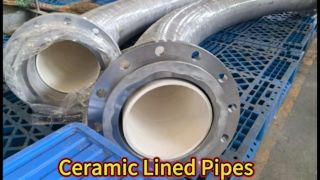
Brief: In this video, we explore how alumina ceramic liners provide a superior wear resistance solution for sand washing hydrocyclones. You'll see a detailed demonstration of their installation process, learn about their exceptional durability compared to traditional metal or rubber liners, and understand how their smooth surface enhances classification efficiency and reduces energy consumption in demanding industrial environments.
Related Product Features:
Custom-designed liners for cyclone cylinders, cone pipes, and outlet pipes with a seamless, gap-free ceramic structure.
Manufactured with 10-25mm thickness using 100-ton dry pressing for high density and superior wear resistance.
High-strength adhesive staggered pasting process ensures firm bonding, suitable for high-impact and dynamic operations.
Smooth inner wall with ceramic height differences under 0.5mm maintains slurry tangential velocity and classification efficiency.
Alumina content ≥95% and density ≥3.8 g/cm³ provide excellent hardness and structural integrity.
Rockwell A hardness ≥85HRA and impact strength ≥1500 MPa ensure long-term performance under abrasive conditions.
Thermal conductivity of 20W/m.K and thermal expansion coefficient of 7.2×10⁻⁶ m/m.K offer stability across temperature variations.
Volume wear ≤0.02cm³ and service life of 5-10 years significantly reduce maintenance frequency and costs.
FAQs:
How does the alumina ceramic liner affect the classification efficiency of the hydrocyclone?
The smooth surface of the ceramic liner ensures a stable slurry flow trajectory, reducing fluctuations in classification accuracy caused by inner wall wear and material buildup, thereby improving the consistency of the finished sand.
Can the ceramic liner be partially replaced if it gets damaged?
Yes, the patch-type ceramic liner supports single-piece replacement without overall disassembly, effectively reducing maintenance time and costs. For integral liners, replacement depends on the extent of the damage.
What is the temperature range that the alumina ceramic liner can withstand?
The ceramic liner operates effectively within a temperature range of -50°C to 150°C, making it suitable for outdoor sand washing production lines in both winter and summer without cracking or deforming.
How does the service life of alumina ceramic liners compare to traditional options?
Alumina ceramic liners typically last 5-10 years, significantly longer than rubber liners (3-6 months) or metal liners (1-3 months), reducing downtime and maintenance costs.