Highlight:
wear-resistant ceramic plates for mining
, ceramic lined mining chutes
, ceramic plates for chute protection
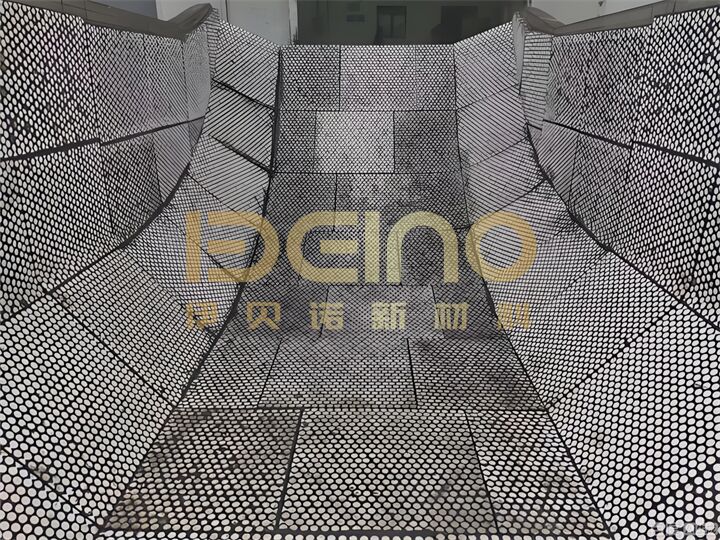
Application of wear-resistant ceramic plates in mining chutes
Product Description
The working environment of mining chutes is extremely challenging, and their wear mechanisms are complex and diverse, mainly manifesting as three core problems: firstly, erosive wear, where high-hardness ore particles fall from a height, impacting the inner wall of the chute at speeds of tens of meters per second, causing strong cutting and chipping effects, especially in areas such as chute corners and material drop points, where wear is more concentrated; secondly, impact wear, where the periodic impact of large ore blocks easily leads to deformation and cracking of the lining plates, and even causes damage to the chute base; and thirdly, corrosive wear, where the humid environment in underground mines and the acidic and alkaline media in the ore slurry accelerate the corrosion of metal lining plates, further reducing their wear resistance.
For a long time, mines have mostly used metal lining plates such as manganese steel and high-chromium cast iron as protective materials for chutes, but the Rockwell hardness of these materials is only HRC50-60, and their wear resistance is limited. Data shows that the service life of traditional metal lining plates is usually only 3-6 months, and in some high-wear areas, it is even less than 1 month. Frequent replacement of lining plates not only requires a large amount of manpower and resources but also causes production line downtime, with a single downtime loss often reaching hundreds of thousands of yuan, placing a heavy operational burden on mining companies. Therefore, the development of protective materials that combine high wear resistance, impact resistance, and corrosion resistance has become an urgent need for the mining industry.

The core advantages of wear-resistant ceramic plates:
Wear-resistant ceramic plates are made from high-purity alumina (Al₂O₃), silicon carbide (SiC), and other core raw materials through high-temperature sintering and precision machining. Their physical and chemical properties comprehensively surpass traditional metal materials, providing comprehensive wear protection for mining chutes. Their core advantages are mainly reflected in the following aspects:
Extreme Wear Resistance
The Mohs hardness of alumina ceramic plates can reach 9 (second only to diamond), and the Rockwell hardness is as high as HRA85 or above. Its wear resistance is 266 times that of manganese steel and 171.5 times that of high-chromium cast iron, effectively resisting the erosion and abrasion of various ore particles. Enhanced ceramic plates with added silicon carbide particles can further increase the hardness to HV1800, improving wear resistance by 25% compared to ordinary ceramic plates, making them suitable for highly abrasive conditions such as ore slurry chutes and slurry pumps.
Balanced Impact Resistance
To address the brittleness of ceramic materials, the industry employs a composite structure design featuring a "ceramic + tough substrate." Through a rubber buffer layer or a special adhesive, the ceramic plate is tightly bonded to a tough substrate, such as a Q235B steel plate. The hard ceramic layer handles wear resistance, while the elastic layer below effectively absorbs the impact energy of the ore, preventing the ceramic plate from cracking and falling off, thus achieving both "high wear resistance" and "impact resistance." Practical tests have shown that this composite structure can withstand an impact strength of 10-15 J/cm², perfectly suited for the high-impact conditions of mining chutes.
Stable Corrosion and High-Temperature Resistance
Alumina ceramics have extremely stable chemical properties, resisting acid and alkali media and ore slurry corrosion without rusting. This makes them suitable for the humid and corrosive complex environments found in underground mines. At the same time, their excellent thermal stability allows them to maintain stable performance in high-temperature environments above 800°C, making them suitable for special conditions such as high-temperature powder conveying, extending the service life by 4-6 times compared to traditional polyurethane rubber liners.
Significant Overall Economic Benefits
Although the initial investment in wear-resistant ceramic plates is higher than that of metal liners, the life-cycle cost advantage is significant. On the one hand, their service life can be extended to 2-5 years, greatly reducing the frequency of liner replacement and downtime; on the other hand, the density of ceramic plates is only 1/3 of that of metal materials, which reduces the overall weight of the chute and lowers driving energy consumption. In addition, the smooth ceramic surface and low friction coefficient reduce material adhesion and clogging risks, improving conveying efficiency. Case studies show that after upgrading a coal mine's chute with ceramic plates, the annual maintenance costs were reduced by over 800,000 yuan, resulting in a return on investment of over 300%.
Product parameters
| Items |
Specifications |
| Content of alumina |
≥95% |
| Density |
≥3.8 g/cm3 |
| Rockwell A hardness |
≥85HRA |
| Impact strength |
≥1500 MPA |
| Fracture toughness |
≥4.0MPa·m1/2 |
| Bending Strength |
≥330MPa |
| Thermal conductivity |
20W/m.K |
| Thermal expansion coefficient |
7.2×10 6m/m.K |
| Volume wear |
≤0.02cm3 |
Application Process and Matching Solutions for Wear-Resistant Ceramic Tiles
The application of wear-resistant ceramic tiles in mining chutes must follow the principles of "condition adaptation and process standardization." The appropriate ceramic type and installation process should be selected based on the chute structure and material characteristics (particle size, hardness, and drop height) to ensure maximum protection.
Comparison of Mainstream Installation Processes
Currently, there are three main installation processes for ceramic liners in mining chutes, each suited to different working conditions:
Adhesive Bonding Method: Ceramic liners are bonded to the inner wall of the chute using high-strength epoxy structural adhesive. This method offers high construction efficiency and a smooth surface, and is suitable for large flat or gently curved chutes and working conditions with material impact strength ≤ 5 J/cm². During construction, the substrate surface must be clean and dry, with a roughness of Ra3.2-Ra6.3 μm. The adhesive layer must be full and free of voids, and the curing time should be at least 24 hours.
Stud Welding Method: Ceramic liners are fixed to the chute base using stud welding. Each stud has a tensile strength of ≥ 15 kN, and the method offers excellent impact resistance, making it suitable for high-drop (≥ 5m) and high-impact working conditions. This process requires proper welding sealing and anti-loosening treatment to prevent slurry penetration and subsequent corrosion of the base material.
Dovetail Groove Composite Process: This method uses a combination of mechanical fasteners and structural adhesive for double fixation. The interface bonding strength is ≥ 8 MPa, and it offers outstanding vibration resistance, making it suitable for chutes, vibrating screens, and other equipment that are subjected to long-term high-frequency vibrations. Its disadvantages include high processing precision requirements and a longer installation period.
Selection method of abrasion-resistant ceramics
| Product model |
Operating temperature (℃) |
Applicable media |
Material particles(mm) |
Scope of application |
| Paste type |
300 |
Powder/Slurry |
≤3 |
Pneumatic conveying of powder or slurry below 300°C |
| Welded |
300-800 |
Powder/Slurry |
≤10 |
Pneumatic conveying of larger particle powder or slurry below 800℃ |
| Dovetail |
≤800 |
Powder/Slurry |
≤200 |
Conveying larger particle powder or high-speed rotating equipment below 800°C |
| Impact resistant |
≤800 |
Granules/Slurry |
≤200 |
Bulk material conveying system below 800℃, especially suitable for a mixture of hard bulk material and powdery material |
| Ceramic rubber composite type |
-50~150 |
Granules/Slurry |
≤10 |
A bulk material conveying system below 150℃, especially suitable for pure soft bulk material conveying, can resist large impact |
Q1: What are the differences between standard ceramic tiles and rubber-backed ceramic composite plates? What are their respective applications?
A1:Ceramic tiles: Directly bonded or bolted in place, offering the highest hardness and superior wear resistance, suitable for straight sections of chutes where sliding wear is the primary mode of wear.
Rubber-backed ceramic composite plates: Ceramic blocks are embedded in rubber, improving impact resistance by 40%. They are suitable for areas with large material impacts and significant vibration, such as crusher outlets and screening machine feed points.
The two can be used in combination, with composite plates used in impact zones and standard ceramic tiles in straight sections, achieving optimal cost-effectiveness.
Q2: How to choose between 92%, 95%, and 99% alumina content?
A2: These three represent different balances of cost-effectiveness:
92% alumina: Economical choice, suitable for medium wear conditions such as coal and limestone, with wear resistance 120 times that of high-chromium cast iron.
95% alumina: Mainstream industrial grade, suitable for most metal and non-metal ores, offering the best cost-performance ratio.
99% alumina: High-performance type, used in extreme wear environments (such as high-hardness materials like silica sand and corundum) or critical parts requiring extremely high wear resistance.
Generally, 95% alumina can meet the needs of 90% of mining applications.
Q3: How long does it take to shut down production for the installation of wear-resistant ceramics?
A3: This depends on the installation plan:
Online quick repair: Local repairs can be performed using fast-curing adhesives, allowing production to resume within 1-2 hours for single-point repairs.
Segmented installation: Large chutes can be installed in three segments, with each segment requiring an 8-12 hour shutdown.
Complete replacement: This requires a 2-3 day shutdown. Compared to replacing traditional metal liners, the time can be reduced by 60%.
Q4: Which is better: adhesive bonding or bolt fastening?
A4:Both have their advantages and are often used in combination:
Adhesive bonding offers several advantages, including no drilling, a smooth surface, and uniform stress distribution. It is suitable for thin ceramics (≤15mm) and flat surfaces.
Bolt fastening: Offers higher mechanical strength and greater impact resistance. It is suitable for thick ceramics (≥20mm) or areas subject to significant vibration.
Combined fastening: For critical areas, a "bond first, then rivet" approach is used, meaning the parts are first bonded with adhesive, and then a small number of bolts are used for auxiliary fastening to ensure complete reliability.
Q5:Will materials stick to or build up on the ceramic surface?
A5: Compared to metal surfaces, ceramics exhibit a significantly reduced tendency for material adhesion:
Smooth surface: The friction coefficient is only 1/3 of that of steel, making it difficult for materials to adhere.
Hydrophobic treatment: A hydrophobic coating is available as an option to prevent the adhesion of wet and sticky materials.
Low surface energy: The low surface free energy of ceramics makes chemical adhesion less likely.
Data shows that the amount of material buildup on ceramic surfaces is 60-80% less than on steel surfaces, making it particularly suitable for handling sticky materials such as wet clay and concentrates.

 Your message must be between 20-3,000 characters!