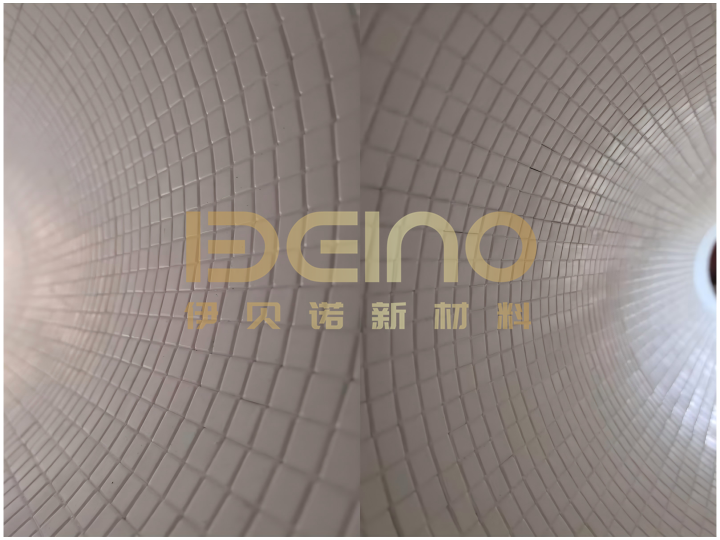
Highlight:
Stainless Steel Hydrocyclone with ceramic lining
, Alumina ceramic lined hydrocyclone
, Hydrocyclone with 95% alumina lining
Stainless Steel Hydrocyclone with 95% Alumina Ceramic Lining
Product Description
The stainless steel hydrocyclone with 95% alumina ceramic lining is designed for high-abrasion slurry classification environments such as sand washing, mining, and mineral processing. It combines a stainless steel structural body and a high-density alumina ceramic wear liner to provide long-term wear protection and stable classification performance.
In most mineral processing and sand washing plants, hydrocyclones are considered simple classification equipment.
But in real field operation, experienced engineers know the truth: The cyclone is not a simple separator — it is one of the most severe wear environments in the entire plant.
Structure & Design
Base structure: carbon steel / stainless steel body
Wear layer: high-density alumina ceramic lining
Installation method: adhesive / modular / bolt-fixed system
The real problem is not the cyclone design — it is wear inside the system
When slurry enters the cyclone at high velocity, it creates a continuous spiral flow.
Inside this flow, hard particles such as silica sand repeatedly impact the inner wall at high speed.
At the beginning, the system works normally.
But over time, the inner surface starts to change:
- Smooth surface becomes roughThe
- The flow trajectory becomes unstable
- Separation accuracy starts to drop
- Energy consumption gradually increases
Why Do Most Stainless Steel Cyclones Fail Under Actual Operating Conditions?
Numerous factories opt for stainless steel hydrocyclones, assuming corrosion is their primary problem. Yet when handling abrasive slurries, corrosion is merely a secondary concern. The root cause of failure is mechanical wear. Not even stainless steel can resist: Persistent impacts from silica sand, high-velocity slurry erosion, and long-term abrasion caused by turbulent flow The outcome is inevitable: The cyclone still breaks down, albeit at a slower rate than carbon steel units.

The real engineering solution: shift the wear surface, not the structure
From a wear protection engineering perspective, the cyclone failure point is always the inner wall.
So instead of upgrading steel, we change the wear interface itself.
This is where 95% alumina ceramic lining becomes critical.
Why 95% alumina ceramic works in hydrocyclones
In hydrocyclone operation, the inner surface must meet three requirements:
- Resist continuous abrasion
- Maintain smooth flow geometry
- Remain stable under long-term slurry impact
95% alumina ceramic satisfies all three conditions simultaneously.
Key technical characteristics:
Alumina content ≥95%
Density ≥3.8 g/cm³
Hardness ≥ HRA 85
Very low volume wear rate
Stable structure under slurry erosion
What changes after the ceramic lining is installed
Once the inner surface is replaced with a ceramic lining, the cyclone is no longer a “consumable wear component”.
Instead, it becomes a stable classification system.
Operators typically observe:
Service life extended to 5–10 years
Significant reduction in shutdown frequency
More stable particle size classification
Lower spare parts consumption
Reduced maintenance labor dependency
Why does this solution reduce cost beyond maintenance
Most buyers initially think ceramic lining is a maintenance upgrade.
But in real operation, the impact goes further.
Because cyclone stability directly affects:
- Sand quality
- Mineral recovery rate
- Downstream equipment load
- Production continuity
In other words: Wear protection is not a spare parts issue — it is a production efficiency issue.
Where stainless steel + ceramic lining is most effective
This composite structure is widely used in:
- Sand washing production lines
- Mining beneficiation plants
- Quartz sand processing systems
- Coal preparation plants
- High-abrasion slurry classification systems

 Your message must be between 20-3,000 characters!