Highlight:
Steel Backed Alumina Ceramic Liner for Chutes and Hoppers
Product Short Description
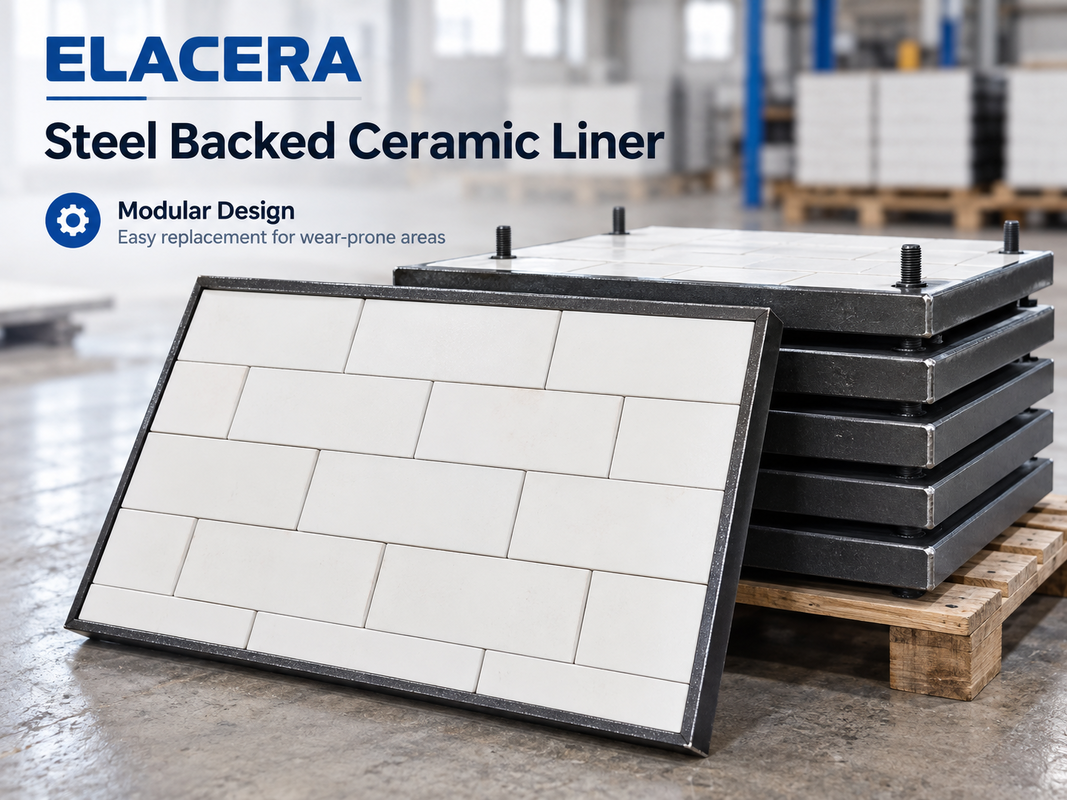
ELACERA steel-backed ceramic liners use high-alumina ceramic tiles bonded to a fabricated steel backing plate. The modular liner protects chutes, hoppers, bins, and transfer equipment exposed to severe sliding abrasion, while the steel backing allows convenient mechanical installation and replacement.
A steel-backed ceramic liner is a modular wear protection panel consisting of wear-resistant alumina ceramic tiles fixed onto a fabricated steel backing plate.
It is mainly used in chutes, hoppers, bins, transfer points, and other bulk material handling equipment where continuous sliding of abrasive materials causes rapid wear of the equipment surface.
Unlike ceramic-rubber-steel composite liners, this design does not contain a rubber cushioning layer. The ceramic provides the wear-resistant working surface, while the steel backing gives the panel structural support and allows the complete liner to be installed or replaced as one unit.
Product Structure
The liner consists of two main parts:
Alumina ceramic wear layer
High-alumina ceramic tiles form the material-contact surface. Their high hardness makes them suitable for resisting continuous abrasion from coal, ash, clinker, ore, mineral powders, and other abrasive bulk materials.

Steel backing plate
The steel plate supports the ceramic layer and provides a strong mounting base. According to the equipment design, the backing can be manufactured with welded studs, threaded bolts, mounting holes, folded edges, or customized steel frames.
The size, ceramic arrangement, and mounting position can all be produced according to the approved drawing.
Why Use Steel Backed Ceramic Liners?
For large equipment surfaces, directly bonding individual ceramic tiles onto the equipment can require considerable installation time and make future maintenance more difficult.
With a steel-backed ceramic liner, the ceramic lining is preassembled onto a steel plate before installation.
This provides several practical advantages:
- modular installation
- easier liner replacement
- shorter maintenance time
- stable ceramic arrangement
- convenient prefabrication
- customized mounting positions
When wear is concentrated in a specific area, individual panels can be replaced without relining the entire equipment surface.
Designed for Sliding Abrasion
Different wear conditions require different liner structures.
For applications with severe impact from large particles, a ceramic-rubber-steel composite liner may provide better impact cushioning.
A ceramic + steel liner is more suitable where sliding abrasion is the dominant wear mechanism and a rigid modular liner structure is preferred.
Typical operating conditions include:
- continuous material sliding
- abrasive powder handling
- fine or medium-sized particles
- moderate impact
- limited installation space
- mechanically mounted liner panels
Liner selection should therefore be based on the actual wear mechanism rather than ceramic thickness alone.
Staggered Ceramic Tile Layout
The alumina ceramic tiles can be arranged in a staggered pattern.
This helps avoid long continuous joints in the direction of material flow and creates a more continuous wear-resistant surface.
The ceramic layout can be adjusted according to:
- material flow direction
- particle size
- material velocity
- impact angle
- equipment geometry
- expected wear pattern
For irregular or non-standard equipment, we can manufacture the ceramic tiles and steel backing plate to customer drawings.
Installation Options
Steel-backed ceramic liners can be supplied with different mounting designs.
Common options include:
- welded studs
- threaded bolts
- mounting holes
- welded steel frames
- customized fixing structures
The backing plate lets you assemble the liner panel before it reaches the site, reducing the ceramic installation work required inside the equipment.
This is particularly useful where shutdown time is limited.
Typical Applications
Steel-backed ceramic liners are commonly installed in:
- transfer chutes
- discharge chutes
- hoppers
- bins
- bunkers
- feeders
- transfer points
- coal handling equipment
- cement handling equipment
- mineral processing equipment
- powder conveying systems
They are particularly suitable for flat or relatively simple wear surfaces where modular panels can be mechanically installed.
Industries
Typical industries include:
Cement Plants
Clinker, raw material, fly ash and powder handling systems.
Mining and Mineral Processing
Ore, concentrate and abrasive mineral transfer equipment.
Power Plants
Coal, ash and pulverized material handling equipment.
Steel Plants
Raw material, coke, sinter and dust conveying systems.
Ports and Bulk Terminals
Bulk material transfer chutes and loading equipment.
Chemical and Powder Processing
Equipment handling abrasive powders and granular materials.
Customized Manufacturing
ELACERA steel-backed ceramic liners can be manufactured according to actual equipment dimensions and operating conditions.
Available customization includes:
- liner length and width
- overall thickness
- ceramic thickness
- steel plate thickness
- ceramic tile dimensions
- tile arrangement
- mounting stud quantity
- bolt positions
- steel frame shape
- edge design
- installation layout
For replacement projects, existing liner drawings, equipment drawings, or sample measurements can be used for technical evaluation.
Information Required for Selection
To recommend a suitable liner structure, it is helpful to provide:
- conveyed material
- particle size
- operating temperature
- material velocity
- impact condition
- installation position
- existing liner material
- liner dimensions
- expected service life
- installation drawing
This information helps determine the appropriate ceramic thickness, steel backing and mounting method.
Manufacturing and Inspection
The steel backing is fabricated first according to the confirmed dimensions and mounting design.
The alumina ceramic tiles are then cut and arranged according to the panel geometry before being securely fixed onto the steel substrate.
Before shipment, the finished liners can be checked for:
- overall dimensions
- ceramic arrangement
- bonding condition
- mounting positions
- steel fabrication
- surface condition
- quantity and identification
For large projects, individual panels can also be numbered according to the installation drawing.
Packaging and Shipping
Steel-backed ceramic liners are packed according to their size, weight, and transportation method.
Heavy liner panels are normally packed on reinforced pallets or in wooden cases to prevent movement and damage during transportation.
Export packaging can be prepared for sea freight, air freight, or multimodal transport.
FAQ
1. What is a steel-backed ceramic liner?
It is a wear-resistant liner made from alumina ceramic tiles fixed onto a steel backing plate. The ceramic resists abrasion while the steel plate provides structural support and mounting strength.
2. What is the difference between a steel-backed ceramic liner and a ceramic rubber steel liner?
A steel-backed ceramic liner contains ceramic and steel only. A ceramic rubber steel liner also contains a rubber layer for additional impact cushioning.
3. When should a ceramic + steel liner be selected?
It is generally suitable where sliding abrasion is the main wear mechanism and a rigid modular liner structure is required.
4. Can the liner dimensions be customized?
Yes. Panel size, ceramic thickness, steel thickness, and mounting positions can all be manufactured according to drawings.
5. Can mounting studs be welded to the back?
Yes. Welded studs, bolts, holes, and other mounting structures can be customized.
6. Can the ceramic layout follow the material flow direction?
Yes. Tile size and arrangement can be optimized according to the equipment geometry and wear direction.
7. What information is required for quotation?
Please provide liner dimensions or drawings, ceramic thickness, steel plate thickness, mounting design, quantity and basic operating conditions.
8. Can replacement liners be manufactured from existing samples?
Yes. Existing drawings, sample measurements, or equipment dimensions can be used for evaluation and reproduction.

 Your message must be between 20-3,000 characters!