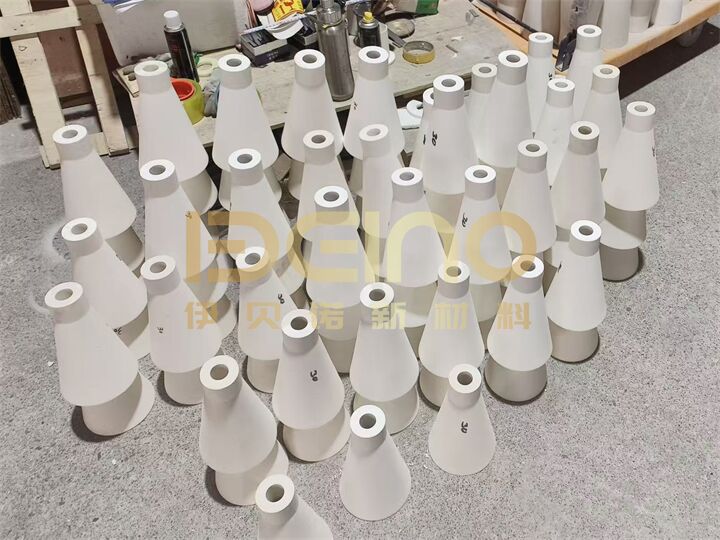
Highlight:
wear resistant alumina ceramic sleeve
, alumina ceramic pneumatic conveying sleeve
, ceramic sleeve for pneumatic pipeline
Wear Resistant Alumina Ceramic Sleeve for Pneumatic Conveying Pipeline
Product Description
The wear-resistant alumina ceramic sleeve is designed for abrasive pneumatic conveying pipelines where powders and fine particles can cause continuous wear on the inner wall of the pipe.
Made from 95% alumina ceramic, the sleeve provides a hard, smooth, wear-resistant surface. Its integral cylindrical structure protects the full circumference of the pipeline and helps reduce longitudinal joints in the material-flow direction.
It is widely used for conveying cement powder, fly ash, coal powder, mineral fines, lithium battery raw materials, and other abrasive bulk materials.
Outer diameter, inner diameter, length, and ceramic thickness can be customized according to the steel pipe dimensions and approved drawing.
Product Features
- 95% alumina ceramic
- Density ≥3.75 g/cm³
- Rockwell hardness ≥85 HRA
- High resistance to abrasive powder wear
- Smooth material-contact surface
- Integral cylindrical lining structure
- Customized outer diameter, inner diameter, and length
- Suitable for different pneumatic conveying pipelines

Technical parameters
| Item |
Specification |
| Material |
95% Alumina Ceramic |
| Al₂O₃ Content |
≥95% |
| Density |
≥3.75 g/cm³ |
| Rockwell Hardness |
≥85 HRA |
| Vickers Hardness |
≥1200 HV10 |
| Fracture Toughness |
≥4.0 MPa·m¹/² |
| Bending Strength |
≥330 MPa |
| Structure |
Integral Ceramic Sleeve |
| Ceramic Thickness |
Customized |
| Dimensions |
According to Drawing |
Application in Pneumatic Conveying Pipelines
Pneumatic conveying systems often transport abrasive powders at relatively high velocity. Continuous contact between the material and the pipe wall can gradually wear the steel surface, especially in pipelines operating for long periods.
Alumina ceramic sleeves are installed inside steel pipes to provide a wear-resistant material-contact layer.
The integral sleeve structure is particularly suitable where full-circumference protection and a smooth internal surface are required.
Typical conveyed materials include:
- Cement powder
- Fly ash
- Pulverized coal
- Mineral powder
- Ash and slag fines
- Lithium battery raw materials
- Other abrasive powders and bulk solids
Sleeve Size and Pipeline Matching
For ceramic sleeve-lined pipelines, the ceramic dimensions should be confirmed together with the steel pipe dimensions.
Important dimensions normally include:
- Ceramic outer diameter
- Ceramic inner diameter
- Sleeve length
- Ceramic wall thickness
- Steel pipe inner diameter
- Adhesive allowance
- Required finished internal diameter
The finished bore is especially important in pneumatic conveying systems because excessive reduction of the internal diameter may affect material velocity and connection with adjacent pipelines.
Customized Processing
ELACERA alumina ceramic sleeves can be manufactured according to customer drawings.
Different diameters, wall thicknesses, and lengths are available depending on the pipeline size and wear conditions.
For a quotation, please provide the ceramic sleeve dimensions or a steel pipe drawing. Information about the conveying material, particle size, operating temperature, pressure, and conveying velocity is also helpful for technical review.
Applications
Wear-resistant alumina ceramic sleeves are commonly used in:
- Cement plants
- Thermal power plants
- Steel mills
- Mining and mineral processing
- Coal handling systems
- Chemical processing
- Lithium battery material production
- Other abrasive pneumatic conveying systems
Packaging
Ceramic sleeves are packed according to their size and quantity.
Protective materials are used between ceramic pieces to reduce collisions during transportation, and the products can be packed in wooden cases for export shipment.
FAQ
Q1: What alumina content is normally used?
A1: Our standard wear-resistant ceramic sleeve is made from 95% alumina ceramic.
Q2: Can the ceramic sleeve dimensions be customized?
A2: Yes. Outer diameter, inner diameter, wall thickness, and length can be manufactured according to drawings.
Q3: What materials can be conveyed?
A3: Typical materials include cement powder, fly ash, coal powder, mineral fines, and lithium battery raw materials.
Q4: What information is required for quotation?
A4: Please provide the ceramic sleeve dimensions or steel pipe drawing together with the conveyed material and operating conditions.
Q5: Why is the finished internal diameter important?
A5: In pneumatic conveying systems, the finished bore can influence material velocity and the connection with adjacent pipe sections, so it should be confirmed before production.

 Your message must be between 20-3,000 characters!