Highlight:
Stainless Steel Ceramic Sleeve Lined Pipe for Lithium Battery Powder Conveying
Product Description
In a lithium battery powder conveying line, the practical question is not simply whether ceramic is harder than stainless steel. The real question is whether the complete powder-contact surface—including ceramic joints, flange transitions, and changes in bore—remains protected and properly aligned.
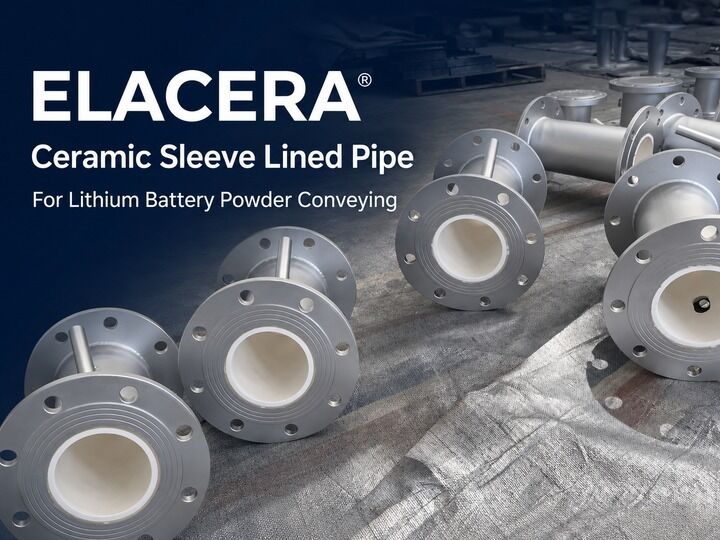
This ceramic-sleeved, lined pipe for lithium battery powder conveying uses integral 95% alumina ceramic rings within a SUS304 or SUS316L stainless steel outer pipe. Each ring provides full-circumference wear protection, while the flanged ends allow the pipe section to connect with the existing conveying system.
Ceramic grade and all powder-contact materials should be confirmed according to the conveyed powder and the customer’s process requirements.
Product Parameters
| Items |
Specifications |
| Outer Pipe Material |
SUS304 or SUS316L stainless steel |
| Ceramic Material |
Mainly 95% alumina ceramic |
| Lining Structure |
Integral ceramic sleeves/rings |
| Composite Structure |
Stainless steel pipe, bonding layer, and ceramic rings |
| Connection |
Flanged |
| Pipe Diameter |
Customized according to drawings |
| Pipe Length |
Customized |
| Ceramic Thickness |
Selected according to operating conditions |
| Flange Standard |
According to customer requirements |
| Main Application |
Lithium battery powder conveying |
The specifications above are general references. Final materials, dimensions, and construction are subject to the confirmed drawing and process requirements.

WHY CAN PIPE WEAR BECOME A MATERIAL QUALITY ISSUE?
Fine cathode or anode material powders can continuously slide against and collide with the pipe wall during conveying. Higher velocity, changes in bore, and local turbulence may concentrate wear within a relatively small area.
If the internal metal surface becomes exposed, the result may be more than a worn pipe. Direct contact between the powder and the metal surface may also increase the risk of unwanted metallic contamination.
A wear protection design for lithium battery powder conveying should therefore answer two questions:
- Where will the material attack the pipe first?
- Can the internal ceramic surface remain continuous at joints and connections?
The required contamination-control level varies between processes. Ceramic-grade adhesive, joint material, and other powder-contact materials should therefore be reviewed against the customer’s actual material specification.
WHERE DOES WEAR USUALLY START?
A straight pipe may appear less critical than an elbow, but local wear can still develop at:
- Flange-end transitions
- Misaligned ceramic ring joints
- Sudden changes in internal diameter
- Exposed ceramic edges
- Pipe inlets where powder enters at an angle
- Positions where local turbulence disturbs the normal flow
A small internal step can repeatedly intercept moving particles. If one ceramic ring is not aligned with the next, the joint may disturb the powder flow and concentrate abrasion around the exposed edge.
For this reason, bore alignment and end transitions can be as important as ceramic hardness and thickness.
WHY USE INTEGRAL CERAMIC RINGS?
Each ceramic sleeve is formed as a complete ring and covers the full inner circumference of the pipe. Multiple rings are assembled along the pipe length to create a continuous ceramic-lined flow path.
Compared with individual ceramic tiles, the sleeve structure has no longitudinal tile joints running in the direction of material flow. This reduces the number of possible exposed gaps and creates a more consistent internal surface.
However, a ceramic sleeve-lined pipe is not completely joint-free. Joints still exist between individual rings. These joints must be tight and properly aligned so that no raised ceramic edge faces the incoming material.
The value of the sleeve design is therefore not simply “more ceramic.” It comes from controlling the number, direction, and alignment of the joints.
Which Lining Structure Fits the Pipe?
| Structure |
Where It Can Fit |
Points to Consider |
| Bare stainless steel pipe |
Low-wear positions where direct metal contact is acceptable |
The metal surface remains exposed to the powder |
| Ceramic tile lined pipe |
Large diameters and complicated pipe shapes |
More individual joints; installation quality is important |
| Ceramic sleeve lined pipe |
Straight sections where integral rings can be manufactured and installed |
Fewer longitudinal joints, but diameter, roundness, and ring alignment must be controlled |
Ceramic sleeves are not automatically the best solution for every pipe. Large diameters, complex fittings, severe impact or unusual internal shapes may require ceramic tiles or a separately engineered lining structure.
Five Design Details That Matter
Finished Internal Diameter
Ceramic thickness reduces the available pipe bore. Selecting a thicker lining without checking the finished internal diameter may change conveying velocity and flow behaviour. The required finished bore should be confirmed before the ceramic ring dimensions are finalized.
Ceramic Ring Alignment
Adjacent rings should remain concentric and form a consistent internal passage. Misalignment can create raised steps that receive repeated particle impact and accelerate local wear.
Flange-End Transition
The ceramic lining should terminate cleanly at both pipe ends. An exposed metal edge, unprotected gap or sudden internal step near the flange may become an early wear point. Where strict metal-contact reduction is required, the entire flange interface and its connection to the next pipe section should be reviewed.
Bonding and Operating Conditions
The bonding system must be selected according to the actual temperature, vibration, and operating environment. Ceramic hardness alone does not determine the operating limit of the complete lined pipe.
Pipe and Flange Design
The stainless steel grade, pipe wall thickness, flange standard, and pressure class must match the pipeline drawing and system requirements. The ceramic lining provides wear protection, but it should not be used to compensate for an unsuitable steel pipe or flange design.
SUS304 or SUS316L?
Both SUS304 and SUS316L stainless steel outer pipes are available.
The final choice should be based on the process environment, customer specification, and pipeline design. SUS316L may be selected for more demanding chemical environments, but it is not automatically necessary for every lithium battery powder line.
The stainless steel grade specified on the confirmed drawing should always take priority.
What Should Be Checked Before Quotation?
Before selecting the ceramic thickness or preparing a quotation, it is useful to confirm:
- Conveyed powder and material specification
- Particle size and conveying velocity
- Operating temperature and pressure
- Existing wear position and failure pattern
- Required finished internal diameter
- Flange transitions and changes in bore
- Required stainless steel grade
- Flange standard and pressure class
- Vibration, impact, or frequent disassembly
- Requirements concerning metallic contamination and powder-contact materials
These details help determine whether an integral ceramic sleeve is suitable and where the pipe design requires additional attention.
Manufacturing and Inspection
Before assembly, the stainless steel pipe, flange dimensions, and ceramic ring fit are checked against the confirmed drawing.
During ceramic installation, attention is given to:
- Ceramic ring sequence and alignment
- Joint condition
- Finished internal diameter
- Internal surface consistency
- Ceramic termination at both pipe ends
Final inspection covers:
- Ceramic-lined bore condition
- Pipe and flange dimensions
- Flange orientation
- Weld appearance
- Ceramic joint alignment
- Overall conformity with the drawing
Additional inspection documents can be prepared according to the agreed project requirements.
Packing and Delivery
Finished ceramic sleeve lined pipes are individually protected and secured on steel racks or packed in suitable reinforced export cases.
Flange faces and pipe ends are protected to reduce the risk of impact, moisture, and foreign-material entry during handling and transportation. Long or heavy pipe sections are fixed according to their dimensions and weight.
Packing marks, product labels and export documents can be prepared according to the project and destination requirements.
FAQ
Q1: Does a ceramic sleeve eliminate metal contact?
A: Not automatically. Ceramic rings protect the main pipe bore, but flange interfaces, transitions, connections, and other powder-contact materials must also be reviewed if strict metal-contact reduction is required.
Q2: Is thicker ceramic always better?
A: No. Ceramic thickness should match the wear conditions and required finished internal diameter. Excessive thickness can reduce the flow area, while insufficient thickness may not provide the expected wear allowance.
Q3: Is a ceramic sleeve better than ceramic tiles?
A: It depends on the pipe geometry and operating conditions. Ceramic sleeves provide full-circumference protection with fewer longitudinal joints. Ceramic tiles are often more flexible for large diameters and complicated shapes.
Q4: Can SUS304 and SUS316L both be supplied?
A: Yes. The final stainless steel grade is selected according to the customer’s drawing, process environment, and technical requirements.
Q5: Is 95% alumina suitable for every lithium battery powder?
A: Not necessarily. It is commonly used for industrial wear protection, but the ceramic grade and all powder-contact materials should be confirmed against the customer’s contamination limits and process requirements.
Q6: Can ceramic sleeves be used in elbows and tees?
A: They may be used when suitable ceramic shapes can be manufactured and installed. However, pipe geometry, impact direction, and manufacturing limits must be evaluated separately. This product page mainly describes flanged straight pipe sections.
Q7: What information is needed for technical evaluation?
A: Please provide the pipe drawing, quantity, conveyed powder, particle size, conveying velocity, temperature, pressure, stainless steel grade, required ceramic thickness, finished internal diameter, and flange standard.
About Elacera
Elacera is the wear protection brand of Hunan Yibeinuo New Material Co., Ltd. We focus on alumina ceramic linings and customized wear protection solutions for industrial conveying equipment.
We do not select a ceramic lining only according to the product name or ceramic thickness. Send us the pipe drawing, operating conditions and information about the existing wear point. Our team will review the wear mechanism, internal transitions, finished bore, and ceramic ring arrangement before recommending a suitable structure.
Elacera — Wear Protection Expert

 Your message must be between 20-3,000 characters!