Highlight:
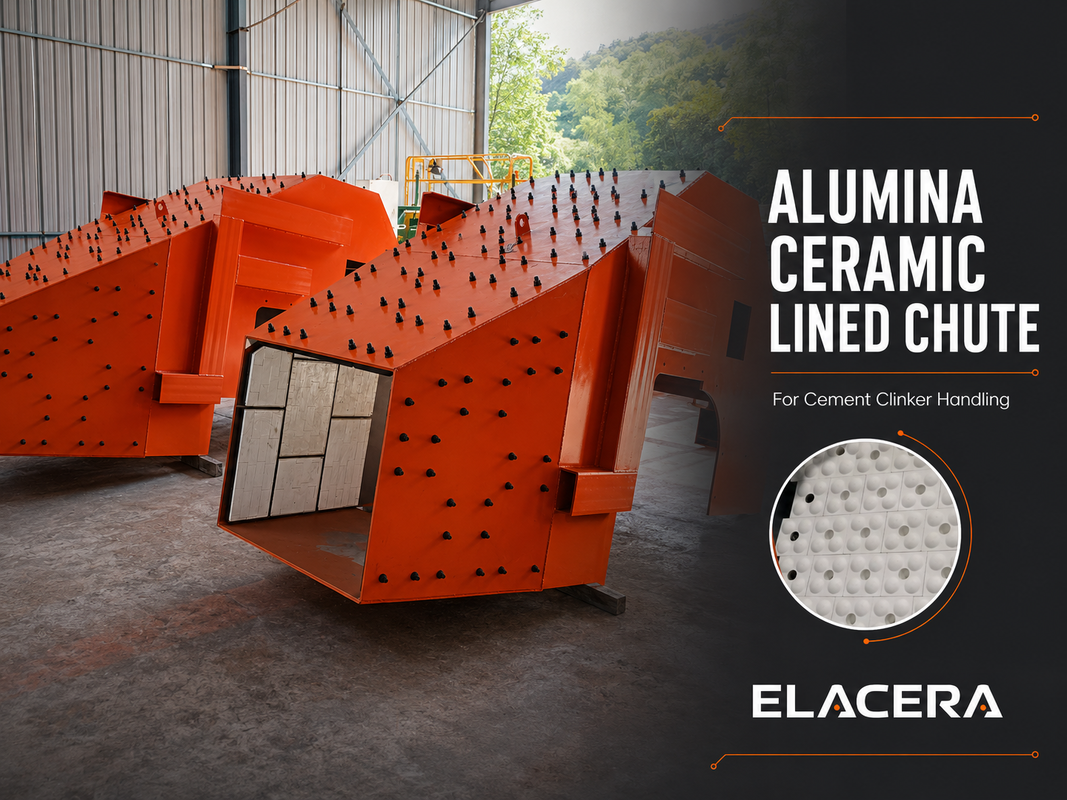
Alumina Ceramic Lined Chute for Cement Clinker Handling
Alumina Ceramic Lined Chute for Cement Clinker Handling
An alumina ceramic-lined chute is a fabricated steel chute protected with wear-resistant ceramic tiles or blocks. It is designed for areas where cement clinker repeatedly impacts or slides across the internal steel surface during material transfer.
The chute body, inlet and outlet dimensions, lining thickness, and connection structure can be manufactured according to the customer’s equipment drawings. Depending on the operating temperature, drop height, vibration, and installation position, the ceramic lining may be bonded, mechanically secured with weldable tiles, or installed using a combination of both methods.
Product Short Description
An alumina ceramic lined chute protects steel surfaces exposed to impact and sliding wear during cement clinker conveying. The chute dimensions, ceramic layout and fixing method can be customized according to the operating conditions and equipment drawings.
Where Does Wear Occur in a Clinker Chute?
Wear inside a clinker chute is rarely distributed evenly.
Material entering the chute may first strike an impact surface and then change direction before sliding toward the outlet. This creates several possible wear zones:
- The first material impact point
- Inclined sliding surfaces
- Corners and changes in direction
- Areas near the inlet and outlet
- Ceramic joints and lining termination points
- Sections where material flow becomes concentrated
Simply installing the same lining across the entire chute may not provide the most suitable result. The ceramic layout should be designed around the actual material flow and the areas where wear is concentrated.

Ceramic Lining Structure
The steel chute is manufactured first, after which alumina ceramic tiles or blocks are arranged across the internal wear surfaces.
The ceramic size and layout are selected according to the chute shape. Flat tiles are suitable for large planar surfaces, while smaller or specially shaped pieces may be required around corners, transitions, and irregular sections.
Where possible, ceramic joints are arranged to avoid continuous straight paths in the material flow direction. The lining termination should also connect smoothly with the adjacent steel or ceramic-lined surface to reduce exposed edges.
Bonded or Weldable Ceramic Lining?
The ceramic fixing method should be selected according to the actual operating conditions.
Bonded Ceramic Tiles
Bonded ceramic tiles provide a relatively smooth internal surface and are suitable when the selected adhesive is compatible with the operating temperature, impact level and installation position.
The steel surface must be properly prepared before installation. Ceramic arrangement, adhesive coverage, and joint control are important parts of the lining process.
Weldable Ceramic Tiles
Weldable ceramic tiles contain a formed installation hole. During installation, a metal fastening component passes through this hole and is welded to the steel chute body. A ceramic cap is then used to protect the fastening position.
The ceramic itself is not directly welded. The metal fixing component provides mechanical retention, while an adhesive or bedding layer may also be used when suitable for the operating conditions.
This structure can be considered for chutes exposed to vibration, overhead installation, larger ceramic sections, or operating conditions where additional mechanical retention is required.
Combined Lining Structure
Different fixing methods can be used in different sections of one chute.
For example, the main sliding surface may use bonded ceramic tiles, while critical impact zones or overhead sections may use weldable ceramic tiles. The final design should be confirmed after reviewing the temperature, drop height, particle size, and existing wear pattern.
Product Features
- Wear-resistant alumina ceramic protects the steel chute surface
- Ceramic layout can follow rectangular, inclined, and transitional chute structures
- Bonded, weldable, or combined fixing methods are available
- Different ceramic thicknesses can be considered for separate wear zones
- Inlet, outlet, flange, and support structures can be customized
- Lining joints and termination areas are arranged according to material flow
- The finished internal dimensions are confirmed before production
- Complete fabricated chutes or ceramic lining components can be supplied
Typical Technical Information
|
Item
|
Typical Description |
| Product structure |
Fabricated steel chute with alumina ceramic lining |
| Ceramic material |
Typically 95% alumina ceramic |
| Ceramic density |
≥3.75 g/cm³ |
| Ceramic form |
Flat tiles, weldable tiles, blocks, or custom shapes |
| Ceramic thickness |
Selected according to the wear conditions |
| Steel body material |
According to the confirmed drawing |
| Steel body thickness |
According to structural requirements |
| Fixing method |
Bonded, mechanically secured, or combined |
| Chute dimensions |
Customized |
| Inlet and outlet |
Customized |
| Connection structure |
Flange, welded connection, or drawing-specific design |
| Applicable material |
Cement clinker and other abrasive bulk solids |
| Operating temperature |
Must be confirmed before selecting the fixing system |
| Finished internal dimensions |
Confirmed before production |
The table describes common manufacturing options and is not a fixed specification. Final parameters should be based on the approved drawing and operating information.
Designing the Impact and Sliding Wear Zones
Impact wear and sliding wear should not always be treated in the same way.
The first impact area may require a different ceramic thickness, block shape, or fixing structure from the downstream sliding surface. If the material changes direction inside the chute, one wall may receive much more concentrated wear than the opposite wall.
The design review should therefore consider:
- Material entry direction
- Drop height
- Particle size and shape
- Material temperature
- Flow rate
- Chute angle
- Vibration and impact
- Existing wear location
- Required finished opening size
These details help determine the ceramic layout and prevent the lining from unnecessarily reducing the material passage.
Ceramic Thickness and Finished Opening Size
A thicker ceramic lining does not automatically mean a better chute design.
Increasing the ceramic thickness reduces the finished internal dimensions. This may affect material flow, especially near narrow outlets, transitions or existing connection points.
Before manufacturing, both the wear-protection requirement and the finished opening size should be confirmed. Different lining thicknesses may be used in separate zones when the wear distribution is clearly understood.
Manufacturing and Inspection
Production begins with a review of the customer’s chute drawing and operating information. The steel body is fabricated before the ceramic layout is arranged according to the internal geometry.
During manufacturing, the following points are checked:
- Steel chute dimensions and connection orientation
- Ceramic material and thickness
- Lining coverage
- Ceramic joint arrangement
- Fixing and bonding condition
- Corners and transition areas
- Lining termination details
- Finished inlet and outlet dimensions
Special attention is given to small cut pieces, exposed steel edges, and abrupt internal steps that may become weak points during material conveying.
Typical Applications
Alumina ceramic lined chutes can be used in abrasive material-handling areas such as:
- Cement clinker transfer chutes
- Cooler discharge transitions
- Bucket elevator inlet and discharge chutes
- Conveyor transfer points
- Silo and hopper discharge sections
- Raw material handling systems
- Abrasive powder and bulk-solid conveying equipment
For unusually high temperatures, severe impact, corrosion, or wet material, the working conditions must be reviewed separately before the lining structure is selected.
Complete Chute or Ceramic Lining Components
Both supply formats are available.
A complete ceramic lined chute can be manufactured when the customer provides a confirmed fabrication drawing. This option allows the steel structure, ceramic arrangement, and connection details to be checked as one assembly.
For existing equipment repaired or lined on site, ceramic tiles, weldable tiles or pre-assembled lining sections can also be supplied according to the dimensions and installation requirements.
Information Required for Quotation
Please provide the following information when requesting a quotation:
- Chute drawing or main dimensions
- Inlet and outlet dimensions
- Material flow direction
- Chute installation angle
- Conveyed material
- Particle size
- Material temperature
- Drop height
- Flow rate or handling capacity
- Existing wear location
- Required ceramic thickness, if specified
- Steel body material and thickness, if required
- Preferred connection and fixing method
If the ceramic fixing method has not been selected, the bonded and weldable options can be reviewed after the operating information is confirmed.
Frequently Asked Questions
Is a weldable ceramic lined chute the same as a welded steel chute?
No. The steel chute body is fabricated by welding, while “weldable ceramic” refers to ceramic tiles containing installation holes for metal fastening components. The ceramic itself is not welded directly to the steel.
Should bonded or weldable ceramic tiles be used?
The choice depends on temperature, vibration, impact, ceramic size, and installation position. Bonded tiles provide a smooth lining surface, while weldable tiles add mechanical retention. Some chutes use both structures in different wear zones.
Can the chute be manufactured from an existing drawing?
Yes. The steel body, inlet, outlet, supports, and connection details can be manufactured according to a confirmed drawing. The ceramic thickness must be considered when checking the finished internal dimensions.
Can different ceramic thicknesses be used in one chute?
Yes. When the impact and sliding wear zones are clearly identified, different lining thicknesses or ceramic shapes can be considered for different sections.
Can only the ceramic lining be supplied?
Yes. Ceramic tiles, weldable ceramic tiles, and selected lining components can be supplied for customer installation. Detailed dimensions and operating information are required before production.
Request a Technical Review
Send us your chute drawing, material information, and existing wear details. We will review the likely impact area, sliding wear zone, ceramic layout and fixing method before preparing the technical quotation.
ELACERA | Wear Protection Solutions

 Your message must be between 20-3,000 characters!