Highlight:
concrete pump truck elbows
, abrasion-resistant concrete pump elbows
, extreme wear concrete pump fittings
Elbows for Concrete Pump Trucks - Extreme Wear & Abrasion Resistance
Product Description
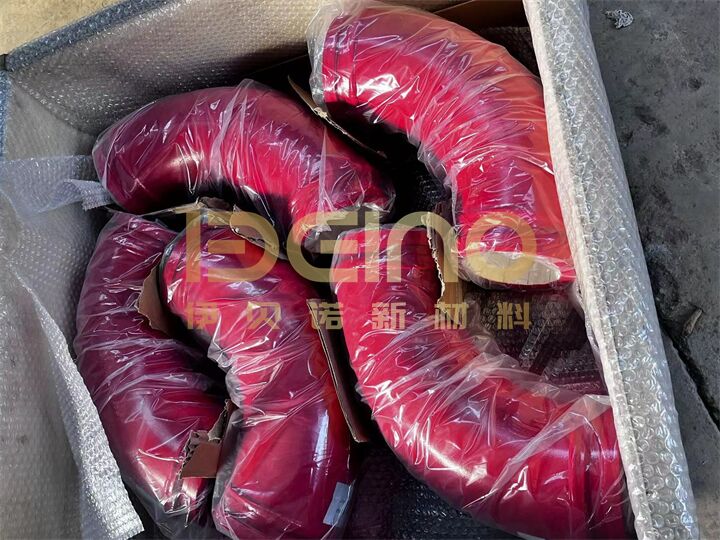
ELACERA® ceramic-lined elbows are replacement wear parts for concrete pump trucks. Small, high-toughness ceramic tiles fit closely along the inner surface, with particular attention to the outer radius, where coarse aggregate causes the strongest impact and sliding wear. The steel elbow carries the structural and connection loads, while the ceramic lining protects the concrete-contact surface.
Product Details
|
Item
|
Specification |
| Brand |
ELACERA® |
| Product Type |
Ceramic-Lined Concrete Pump Elbow |
| Applicable Equipment |
Concrete Pump Truck |
| Inner Diameter |
125 mm |
| Model / Part No. |
175-175 / 11619406 |
| Ceramic Material |
Alumina-Zirconia High-Toughness Ceramic |
| Available Lining Thickness |
4–10 mm |
| Outer Structure |
Steel Elbow |
| Connection |
Welded End Collars, Installed by Pump Clamps |
| Surface Treatment |
Painting |
| Application |
Concrete Pumping in Construction Projects |
| Custom Production |
According to Confirmed Drawing or Sample |
| Packaging |
Wooden Case or Steel Rack |
| Delivery Time |
Normally 25–45 Working Days |

Wear Is Concentrated on the Outer Bend
A pump elbow does not wear evenly around its circumference. As concrete changes direction, coarse aggregate is pushed against the outside radius of the elbow. Repeated impact and sliding gradually remove material from this area, while the inside radius may still appear usable.
The severity of wear also changes with the bend radius, pumping pressure, aggregate grading, and consistency of the concrete mix. For this reason, the ceramic arrangement should follow the actual direction of material flow instead of being treated as a simple decorative lining.
The small ceramic tiles used inside the elbow can follow the curved surface more closely than large flat pieces. During production, the tile position, joint width, and coverage around the outer bend are checked before the assembly is completed.
Typical ZTA Ceramic Parameters
| Items |
Specifications |
| Al2O3 |
≥75% |
| Zirconia |
≥21% |
| Density |
4.2 g/cm3 |
| Compressive Strength |
≥ 1400 MPa |
| Rockwell Hardness |
≥ 90 HRA |
| Vickers Hardness |
≥ 1350 HV10 |
| Fracture Toughness (KIC) |
≥ 5.5 Mpa.m1/2 |
| Bending Strength |
≥ 350 MPa |
| Wear Volume |
≤ 0.009 cm3 |
The values above describe the ceramic material used for this product. Final parameters should follow the confirmed grade, test method, and order specification.
Fitment Matters as Much as Ceramic Hardness
In practice, a replacement elbow cannot be selected from the nominal diameter alone. Two DN125 elbows may have different bend angles, center-line radii, end-collar dimensions or installed lengths.
An incorrect transition at either end can leave a raised edge inside the pipeline. Concrete and aggregate repeatedly striking this edge may cause local wear, turbulence or material buildup. Incorrect collar dimensions may also affect clamp installation and sealing.
Before production, the following details should be checked against the existing pump line:
- Nominal inner diameter
- Elbow angle
- Center-line radius
- Overall and installed length
- End-collar type and dimensions
- Wall and ceramic lining thickness
- Pump-truck model or original part number
- Position of the most heavily worn area
When an old elbow is available, a sample or clear dimensional drawing provides a more reliable reference than the equipment model alone.
Installation and Inspection
Before fitting the elbow, check the two end transitions for exposed steel, loose ceramic pieces, or an obvious step between the liner and the adjoining pipe. The clamp collars and sealing surfaces should be clean and correctly aligned.
After installation, the elbow should not be forced into position by the clamp. Misalignment places additional load on the collars and may create an uneven internal transition. The pipeline supports should also be checked so that the elbow does not carry loads caused by an unsupported straight section.
Periodic inspection should focus on the outside radius, the ceramic-to-steel transition at both ends, and the clamp connection. These areas normally reveal developing wear earlier than the painted exterior surface.
FAQ
Why does the outside radius of a pump elbow wear first?
Concrete and aggregate continue moving outward as the flow changes direction. This concentrates impact and sliding wear on the outer radius of the elbow.
Is the ceramic fitted around the full circumference?
The ceramic layout depends on the elbow structure and operating conditions. Full-circumference lining can be supplied, while the outer bend may use a reinforced arrangement where impact is more severe.
Can an elbow be selected using only the DN125 size?
No. The bend angle, center-line radius, installed length, collar dimensions, and original part number should also be confirmed.
Why are small ceramic tiles used inside the elbow?
Smaller pieces follow the curved internal surface more closely. They also allow the lining arrangement to match the bend geometry and concentrate protection in the main wear area.
Can the elbow be manufactured from an old sample?
Yes. An existing elbow can be used to confirm the angle, radius, end connection, and installed dimensions. Critical measurements should still be approved before production.
What should be checked when replacing the elbow?
Check the end transitions, clamp collars, sealing surfaces, ceramic condition, and pipeline alignment. There should be no loose lining, exposed steel or significant internal step at the connection.
For replacement, provide the original part number together with the elbow angle, center-line radius, end dimensions, and photos of the worn area. ELACERA® will check the fitment details before production.

 Your message must be between 20-3,000 characters!