Highlight:
wear resistant ceramic sleeve
, alumina ceramic ring lined pipe
, ceramic sleeve lined steel pipe
Wear Resistant Ceramic Sleeve for Steel Pipe with Alumina Ceramic Ring Lining
Product Description
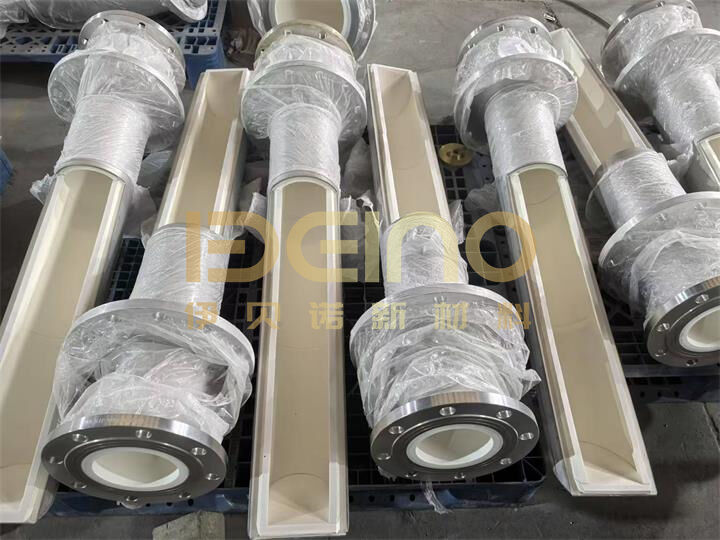
A wear-resistant ceramic sleeve is designed to protect steel pipelines used in abrasive material conveying systems. The sleeve adopts high-hardness alumina ceramic rings installed inside a steel pipe, forming a durable ceramic-lined structure that effectively prevents rapid wear.
The outer pipe can be manufactured from carbon steel or stainless steel, depending on working conditions. Carbon steel is suitable for general bulk material conveying, while stainless steel is recommended for corrosive or high-humidity environments.
The ceramic lining handles abrasion, while the steel shell provides structural strength. This ceramic-lined steel pipe is widely used in pneumatic conveying systems and high-wear pipeline sections.
Products Feature
∗High-density alumina ceramic ring lining
∗Carbon steel or stainless steel outer pipe is optional
∗Excellent wear resistance for powder conveying
∗Smooth ceramic inner surface reduces friction
∗Resistant to corrosion and high temperature
∗Suitable for straight pipe and elbow sections

| Item |
Specification |
| Product Name |
Wear-Resistant Ceramic Sleeve |
| Lining Material |
Alumina Ceramic |
| Ceramic Type |
Ceramic Ring Lining |
| Alumina Content |
92% / 95% / 99% |
| Hardness |
≥ HRA 85 |
| Density |
≥ 3.6 g/cm³ |
| Water Absorption |
≤ 0.01% |
| Working Temperature |
≤ 1000°C |
| Outer Pipe Material |
Carbon Steel / Stainless Steel |
| Installation Type |
Bonded Ceramic Rings |
| Applicable Medium |
Powder / Bulk Material |
| Application |
Pneumatic Conveying |
| Wear Resistance |
Excellent |
| Corrosion Resistance |
Good |
| Surface Finish |
Smooth Inner Surface |
Product Advantages
∗Compared with traditional steel pipes, the wear-resistant ceramic sleeve offers practical operational benefits:
∗Significantly longer pipeline service life
∗Reduced maintenance frequency
∗Lower replacement cost
∗Improved conveying efficiency
∗Reduced metal contamination
∗Stable performance in high velocity transport
Straight Pipe Dimensions (Customizable)
| Inner Diameter (mm) |
Length (mm) |
Ceramic Thickness (mm) |
| 50–100 |
500–2000 |
5–10 |
| 100–150 |
500–2000 |
8–15 |
| 150–200 |
500–2000 |
10–20 |
| 200–300 |
500–2000 |
12–25 |
| 300–500 |
500–2000 |
15–30 |
| Inner Diameter (mm) |
Angle |
Radius (R) |
Ceramic Thickness (mm) |
| 50–100 |
30° / 45° / 60° / 90° |
1D / 1.5D |
8–15 |
| 100–150 |
30° / 45° / 60° / 90° |
1D / 1.5D |
10–20 |
| 150–200 |
30° / 45° / 60° / 90° |
1D / 1.5D |
12–25 |
| 200–300 |
30° / 45° / 60° / 90° |
1D / 1.5D |
15–30 |
| 300–500 |
30° / 45° / 60° / 90° |
1D / 1.5D |
15–30 |
Structure Design
The wear-resistant ceramic sleeve consists of:
Inner layer: Alumina ceramic rings
Fixing method: High-strength adhesive bonding
Outer shell: Carbon steel pipe / Stainless steel pipe
Connection: Welding or flange installation
Application Industries
∗Cement plant conveying systems
∗Steel plant dust pipelines
∗Thermal power plant ash handling
∗Mining and mineral processing
∗Coal conveying systems
∗Port bulk material handling
∗Chemical powder transport
∗Metallurgy industry pipelines
FAQ
Q1:What material is used for the outer steel pipe?
A1:The outer pipe can be carbon steel or stainless steel. Carbon steel is commonly used for general conveying conditions, while stainless steel is recommended for corrosive or humid environments.
Q2:What is the ceramic lining structure?
A2:The inner lining consists of high-hardness alumina ceramic rings installed inside the steel pipe to form a continuous wear-resistant surface.
Q3:Where is this ceramic sleeve typically installed?
A3:It is mainly installed in high wear areas such as elbows, vertical pipes, and pneumatic conveying pipelines.
Q4:How long is the service life compared with a normal steel pipe?
A4:Under similar working conditions, the service life is usually several times longer than that of traditional steel pipe.
Q5:Can the ceramic sleeve handle high temperature?
A5:Yes, alumina ceramic lining has excellent high-temperature resistance and is suitable for most industrial conveying systems.
Q6. Is customization available?
A6:Yes, diameter, length, ceramic thickness, and steel material can all be customized according to working conditions.
Q7:Does the ceramic ring lining affect material flow?
A7:No. The ceramic surface is smooth and actually helps reduce friction and improve conveying efficiency.
Q8: What industries use this product most?
A8:It is widely used in cement, steel, mining, coal handling, power plants, ports, and chemical industries.
Q9:How is the ceramic installed inside the steel pipe?
A9:The ceramic rings are fixed using high-strength adhesive combined with structural locking to ensure long-term stability.
Q10:Can it be used for pneumatic conveying systems?
A10:Yes, it is especially suitable for high velocity pneumatic powder conveying pipelines.

 Your message must be between 20-3,000 characters!