Highlight:
Ceramic Ring Lined Steel Pipe for Fly Ash Conveying
Product Description
When a fly ash conveying pipe wears through, replacing it with a harder pipe is only part of the solution.
The replacement pipe must also match the existing pipeline, maintain the required finished internal diameter, and avoid unnecessary steps or exposed steel at the connections.
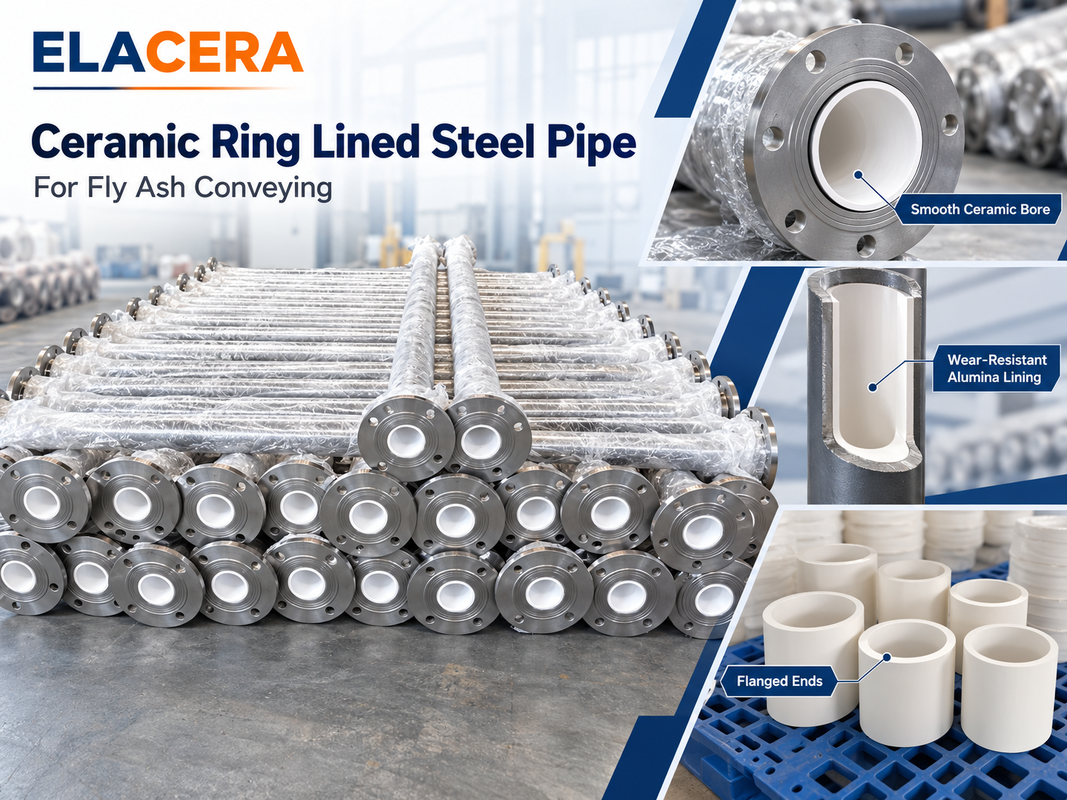
ELACERA manufactures steel pipes lined with sintered alumina ceramic rings for abrasive material conveying. This structure is also commonly referred to as a ceramic sleeve-lined pipe.
Instead of considering the ceramic lining separately, we review the steel pipe, ceramic thickness, finished bore, and connection dimensions together so that the completed pipe can fit the actual conveying system.

Why Do Some Fly Ash Conveying Pipes Wear Faster Than Others?
In pneumatic conveying systems, fly ash particles travel through the pipeline at velocities determined by the conveying arrangement and operating conditions.
Repeated particle contact gradually removes material from the internal surface, but the wear is not always uniform.
Changes in flow direction, local velocity, pipe geometry, and internal alignment can increase particle contact in certain areas. Abrupt changes in bore diameter or steps between adjacent pipe sections may also disturb the particle flow and create localized wear.
For this reason, simply increasing the ceramic thickness is not always the best solution.
Before recommending a pipe construction, it helps to understand where the existing pipe is wearing and whether the problem is mainly general abrasion, local flow conditions, or connection geometry.
How Does Ceramic Ring Lining Protect the Steel Pipe?
The wear-resistant layer consists of sintered alumina ceramic rings installed inside the steel pipe.
Each ceramic ring covers the full internal circumference of one pipe section, and multiple rings are arranged along the pipe length to form the required wear-resistant lining.
Compared with individual ceramic tiles, the ring-type structure avoids longitudinal tile joints around the pipe wall. Joints remain between adjacent ceramic rings, so ring alignment and installation quality are important.
For straight pipe sections, this structure provides a relatively continuous circumferential wear surface.
The outer steel pipe provides structural strength and connection support, while the alumina ceramic lining protects the internal surface exposed to abrasive material.
The fixing method should be selected together with operating temperature, vibration, mechanical loading, and pipe geometry.
The Finished Bore Matters More Than Many Buyers Expect
One dimension we pay particular attention to is the finished internal diameter after ceramic lining.
If a customer specifies only the steel pipe diameter and then adds a ceramic lining inside it, the final flow passage may become smaller than the original pipe.
In a pneumatic conveying system, a reduced flow area can increase local gas velocity and influence pressure loss and particle behavior.
For replacement projects, it is therefore important to confirm whether the dimensions on the drawing refer to:
- Steel pipe internal diameter before lining
- Finished internal diameter after ceramic lining
- Minimum allowable bore at the connection
These values are not always the same.
Ceramic thickness should therefore be selected together with the required finished bore rather than considered independently.
Flange Connections Also Need Wear Protection
For a flanged ceramic-lined pipe, the connection area deserves the same attention as the main pipe body.
If the ceramic bore does not align properly with the adjoining pipeline, an internal shoulder or exposed steel edge may remain.
Depending on the conveying conditions, this can disturb the flow and contribute to localized wear.
When reviewing a replacement pipe drawing, we normally check:
- Flange standard
- Bolt-hole arrangement
- Face-to-face length
- Finished ceramic-lined bore
- Ceramic termination position
- Gasket and installation requirements
A pipe may look correct from the outside but still require dimensional adjustment internally to fit the existing conveying system properly.
Selecting the Ceramic Lining for the Application
Not every fly ash conveying line operates under the same conditions.
Before recommending an alumina ceramic grade, lining thickness, or fixing arrangement, we consider several operating factors.
Conveyed material
Fly ash, cement powder, and other abrasive materials may have different particle characteristics and wear behavior.
Conveying conditions
Particle velocity, conveying pressure, and operating mode influence the wear conditions inside the pipe.
Operating temperature
The alumina ceramic itself may withstand temperatures higher than the bonding or fixing materials used in the complete lining system. The temperature capability of the entire assembly must therefore be considered.
Pipe dimensions
The required finished bore, installation space and connection dimensions influence the final pipe construction.
Existing wear location
Straight pipes, elbows, reducers and other fittings can experience different wear patterns and may require different lining arrangements.
For high-temperature applications, the ceramic material alone should not be used to determine whether a ceramic-lined pipe is suitable. Thermal expansion between steel and ceramic, the fixing method, and the operating cycle must also be evaluated.
Replacement Projects and New Pipeline Installations
For replacement projects, the existing pipe drawing is usually the best starting point.
If the original pipe has failed prematurely, photographs showing the worn area are also useful because they can help identify whether the wear is distributed along the pipe wall or concentrated near a connection or local flow disturbance.
For new pipeline projects, the review normally starts with the conveyed material, operating conditions, system layout and required pipe dimensions.
In both cases, the objective is the same: to select a wear-resistant pipe construction that protects the steel pipe without introducing unnecessary dimensional or installation problems.
What Should Be Checked Before Delivery?
For customized ceramic-lined pipe sections, the following items should normally be checked before shipment:
- Flange dimensions, drilling and alignment
- Overall pipe length
- Finished ceramic-lined internal diameter
- Ceramic ring positioning and visible joints
- Ceramic lining condition at both ends
- Surface coating and external condition
- Protective packing for transportation
Inspection requirements and documentation can be agreed upon according to the project specification
What Information Do We Need for a Quotation?
For an initial review, a pipe drawing and a short description of the operating conditions are usually sufficient.
If available, please also provide:
- Conveyed material
- Operating temperature
- Operating pressure
- Pipe quantity
- Flange standard
- Required finished internal diameter
- Existing wear location
If the ceramic grade or lining thickness has not yet been determined, ELACERA can review the available operating information and discuss suitable options before the specification is finalized.
Frequently Asked Questions
1. Can you manufacture ceramic-lined pipe sections according to our existing drawings?
Yes. We can review customer drawings and manufacture customized pipe sections where the required dimensions and construction are technically feasible. For replacement projects, the finished internal diameter and connection dimensions should be clearly identified.
2. Should we specify the steel pipe diameter or the finished ceramic bore?
Ideally, both. If the pipe is replacing an existing conveying line, the required finished bore is especially important because the ceramic lining reduces the available internal diameter.
3. Is a thicker ceramic lining always better for wear resistance?
Not necessarily. Ceramic thickness affects the finished bore and should be considered together with the operating conditions, ceramic material and overall pipe design.
4. Can ceramic ring-lined pipes be used at 400°C?
This requires a separate technical review. The temperature resistance of alumina ceramic alone does not confirm the suitability of the complete pipe. The fixing method, thermal expansion, operating cycle, and mechanical conditions must also be evaluated.
5. Are ceramic ring lined pipes suitable for bends and elbows?
Ceramic-lined elbows can be supplied, but the construction depends on the bend geometry and manufacturing method. The ceramic ring arrangement used for straight pipes should not automatically be assumed suitable for every elbow.
6. What if our drawing does not specify the ceramic grade or thickness?
Please provide the available operating data and required pipe dimensions. We can review the application and discuss appropriate lining options before finalizing the specification.
Discuss Your Fly Ash Pipeline Wear Problem with ELACERA
If you are replacing worn fly ash conveying pipes or preparing a new pneumatic conveying project, send us your pipe drawings and operating information.
We can review the ceramic lining arrangement, finished bore and connection details before preparing a quotation.
ELACERA | Wear Protection for Industrial Conveying Systems

 Your message must be between 20-3,000 characters!