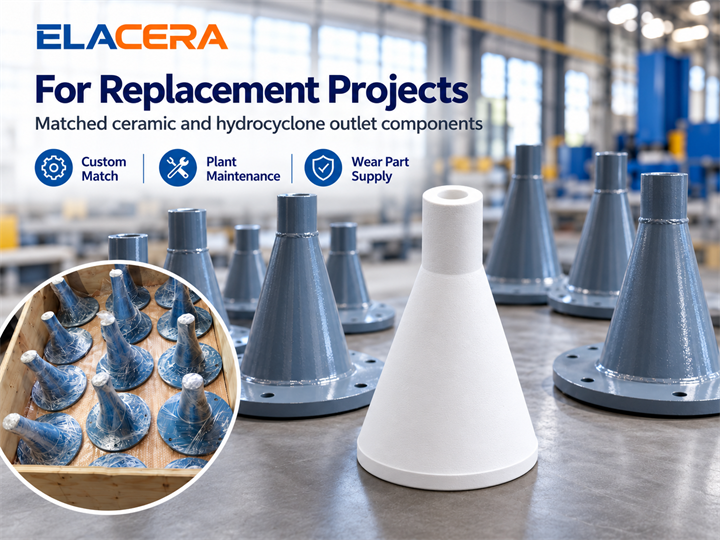
Highlight:
Product Description
Alumina ceramic hydrocyclone spigot liners for abrasive mineral slurry service. Custom apex liners are manufactured to drawings, samples, and required bore dimensions.
The spigot, also called the apex, is one of the smallest parts of a hydrocyclone, but it works in one of the most demanding wear zones.
During classification, the underflow slurry passes through this opening at high velocity. Solid particles continuously contact the inner surface, and the combination of abrasion, local turbulence, and high solids concentration can gradually enlarge the outlet diameter.
For maintenance teams, the concern is not only that the liner eventually wears through.
As the apex opening changes, the underflow condition changes with it. This can affect the way the hydrocyclone operates and may influence separation stability, underflow density, and overall process consistency.
This is why we normally look at a hydrocyclone spigot liner as both a wear component and a dimensional component.
For highly abrasive mineral slurry applications, an alumina ceramic spigot liner can provide a more stable, wear-resistant surface where conventional elastomer liners wear too quickly or where maintaining the outlet geometry is especially important.

Why the apex wears so quickly
The apex is continuously exposed to concentrated solids leaving the hydrocyclone.
Compared with many other equipment surfaces, the wear here is highly localized. The outlet area is relatively small, the slurry velocity is high, and particles repeatedly pass through the same internal surface.
Depending on the ore, particle size distribution, slurry concentration, and operating pressure, the wear pattern may not always be uniform.
In practice, we often pay particular attention to:
- the internal bore,
- the entrance transition,
- the discharge edge,
- and any local area where the slurry flow becomes disturbed.
Once these areas begin to wear, the internal diameter can gradually increase.
A larger opening may still look mechanically acceptable, but from an operating point of view, the geometry is already different from the original design.
That is one reason why simply asking, “How long will the liner last?”, is usually not enough.
A better question is:
How well can the liner maintain the required apex geometry throughout its service period?
Why alumina ceramic is used in hydrocyclone spigots
Alumina ceramic is widely used in abrasive handling equipment because of its high hardness and good resistance to sliding wear.
In a hydrocyclone spigot, the ceramic forms the wear surface directly exposed to the slurry, while the surrounding housing or support structure provides the mechanical connection to the cyclone.
For suitable applications, the main advantage is not only slower material loss.
A ceramic liner can also help maintain a more stable internal diameter over time because the wear-resistant surface does not erode as quickly as many softer materials.
This can be particularly useful in mineral processing plants handling abrasive materials such as iron ore, copper ore, gold ore, coal preparation feed, or other mineral slurries.
However, ceramic is not automatically the best answer for every hydrocyclone.
If the operating condition involves severe impact from large particles, strong mechanical shock, or poor installation support, the liner structure needs to be reviewed carefully.
Material selection should always match the actual wear mechanism.
Typical Product Information
| Item |
Description |
| Product |
Hydrocyclone Spigot / Apex Liner |
| Wear Material |
Alumina Ceramic |
| Application |
Hydrocyclone underflow/slurry classification |
| Main Wear Mechanism |
Abrasive slurry wear |
| Bore Diameter |
Customized |
| Outer Dimensions |
Customized |
| Structure |
Ceramic liner or ceramic insert according to existing assembly |
| Manufacturing Basis |
Drawing, sample, or confirmed dimensions |
| Typical Industries |
Mining, mineral processing, coal preparation |
| Custom Production |
Available |
The internal diameter matters more than many buyers expect
When customers send us an inquiry for hydrocyclone apex liners, one of the first dimensions we check is the finished internal diameter.
This is not simply a manufacturing dimension.
It is part of the hydrocyclone operating condition.
Two liners can look almost identical from the outside, but a different internal diameter may create a different underflow opening.
For replacement parts, we therefore prefer to confirm the original liner drawing, existing dimensions or a sample before production.
The main dimensions normally include:
Outer diameter, total height, finished bore diameter, wall thickness, locating dimensions and connection details.
If the liner fits into a metal housing or polyurethane component, the interface dimensions are also important.
A ceramic component that is highly wear-resistant but does not fit the existing assembly correctly is not a practical solution.
One-piece ceramic or ceramic-lined structure?
Hydrocyclone spigot designs vary between manufacturers and plants.
Some applications use a relatively simple ceramic insert, while others require the ceramic wear component to work together with a steel, rubber or polyurethane supporting structure.
We do not recommend deciding the structure only from a product photo.
The correct design depends on the actual assembly method, operating load, required bore size, and replacement procedure.
For custom replacement projects, we normally review the original component and then decide whether the ceramic should be produced as:
- a one-piece alumina ceramic liner,
- a ceramic insert fitted into an outer housing,
- or a customized ceramic wear component manufactured to match the existing apex assembly.
For ceramic parts with complex geometry or relatively thick sections, forming and firing also need to be considered carefully because dimensional control becomes more difficult as the component size and shape become more complex.
This is one area where experience with industrial ceramic wear parts matters more than simply quoting an alumina percentage.
What we check before recommending a ceramic spigot liner
For a new project, we normally want to understand the hydrocyclone before discussing the final ceramic design.
The most useful information is usually the hydrocyclone model, existing apex size, required finished bore, slurry material, approximate particle size, solids concentration and current liner material.
The wear pattern of the existing part is also very useful.
For example, if the existing liner shows relatively uniform internal abrasion, the solution may be straightforward.
If one side is heavily worn while the opposite side remains relatively intact, that may indicate a flow, alignment, or operating issue that should be considered before simply replacing the material.
Photographs of the worn component can often tell us more than a general statement such as “the liner wears too fast.”
Custom alumina ceramic spigot liners for replacement projects
Most hydrocyclone wear parts are not truly universal.
Even when the nominal cyclone size is the same, the apex design, outer dimensions, and assembly method can vary between equipment manufacturers.
For this reason, ELACERA can produce alumina ceramic hydrocyclone spigot liners according to customer drawings, samples, or confirmed dimensions.
For replacement projects, our main concern is that the ceramic component should not only provide wear resistance, but also match the existing equipment accurately enough for practical installation and operation.
Before production, we normally confirm the critical dimensions and the required interface with the surrounding component.
After firing and finishing, the bore and main fitting dimensions are checked again before shipment.
For maintenance teams, this helps reduce one of the most common problems with custom ceramic wear parts:
a liner that looks correct, but does not fit correctly when it reaches the site.
A wear part should protect the process, not only the equipment
Hydrocyclone spigot liners are relatively small compared with pipelines, cyclones, or slurry pumps.
But their location makes them important.
When the apex wears, the issue is not only the replacement cost. The change in outlet geometry can gradually affect the way the cyclone operates.
That is why we prefer to treat the spigot as a process wear component rather than simply a ceramic spare part.
The right solution should consider both sides of the problem:
wear resistance and dimensional stability.
If you are replacing an existing hydrocyclone spigot or apex liner, sending us the original drawing, worn-part photos or key dimensions is usually the fastest way to evaluate whether an alumina ceramic solution is suitable.

 Your message must be between 20-3,000 characters!