Highlight:
Wear Resistant Ceramic Pipe Corrosion Resistance Wear Resistant Ceramic Pipe
, Wear Resistant Ceramic Pipe ODM
Corrosion Resistance Wear Resistant Ceramic Pipe in cement
Product Description
Cement production involves several abrasive materials, but they do not create the same wear pattern. Fine raw meal may cause continuous sliding abrasion, while clinker dust and coarse particles can produce more concentrated wear at elbows, reducers, and connection points.
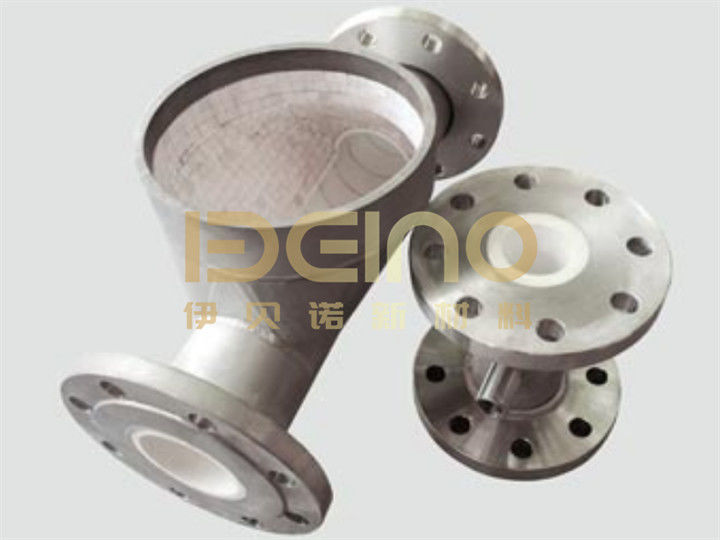
ELACERA ceramic-lined pipes use a steel outer pipe with a 95% alumina ceramic wear layer. The pipe can be manufactured for specific cement plant positions, with the ceramic layout, thickness, and connection design selected according to the conveyed material and operating temperature.

Where Pipeline Wear Occurs in a Cement Plant
Straight steel pipes usually wear gradually. Direction changes and transitions often deteriorate faster because particles repeatedly contact the same area.
Typical wear positions include:
- Raw meal pneumatic conveying lines
- Coal mill outlet and pulverized coal pipes
- Clinker dust conveying sections
- Cement and fly ash transfer pipes
- Elbows downstream of fans or blowers
- Reducers and expanding transitions
- Branch pipes and discharge connections
The actual lining design should follow the wear mechanism at each position. A straight pipe handling fine powder may not require the same ceramic thickness as an elbow exposed to high-velocity clinker particles.
Product parameters
| Items |
Specifications |
| Content of alumina |
≥95% |
| Density |
≥3.75g/cm3 |
| Rockwell A hardness |
≥85HRA |
| Impact strength |
≥1200 MPA |
| Fracture toughness |
≥4.8MPa·m1/2 |
| Bending Strength |
≥350MPa |
| Thermal conductivity |
20W/m.K |
| Thermal expansion coefficient |
7.2×10 6m/m.K |
These values describe the ceramic material. The operating limit of the finished pipe also depends on the steel body, adhesive or fixing system, connection design, and actual working conditions.
Staggered Ceramic Layout for Powder Conveying
Alumina ceramic tiles are arranged along the internal surface of the steel pipe. A staggered layout helps avoid long continuous joints in the material-flow direction.
At elbows, the outer radius normally receives more particle contact than the inner radius. Tile dimensions and arrangement therefore need to follow the bend geometry, leaving as few exposed gaps as practical.
The lining should also maintain a smooth transition at both pipe ends. A raised ceramic edge or exposed steel step can disturb the powder flow and create a new local wear point.
Welded, flanged, and clamped connections are available. The selected connection must match the existing cement plant pipeline and allow sufficient space for installation and maintenance.
Understanding Corrosion Resistance
Alumina ceramic has good chemical stability and is suitable for contact with many industrial powders. Its dense surface also provides a barrier between the conveyed material and the internal steel surface.
However, the ceramic lining does not automatically make every part of the pipe corrosion-proof. The external steel shell, welds, flanges and exposed pipe ends may still require suitable material selection, coating or other protection.
If the pipeline is exposed to acidic gases, alkaline liquids, wash water or chemical additives, the medium concentration and operating temperature should be confirmed before selecting the steel material and bonding system.
Selecting the Pipe for the Process Position
For raw meal and cement powder, attention should be paid to continuous sliding abrasion and the smoothness of the internal flow path.
For clinker dust or mixed coarse particles, elbows and transitions may require thicker ceramic or additional protection at the main wear area.
Coal mill and kiln-related pipelines may operate at elevated temperatures. In these positions, the ceramic fixing method and allowable temperature of the complete lining system must be checked rather than relying only on the heat resistance of the ceramic itself.
Before production, confirm:
- Conveyed material and particle size
- Straight pipe, elbow, or transition position
- Material velocity and conveying method
- Normal and maximum operating temperature
- Steel pipe diameter and wall thickness
- Required finished internal diameter
- Connection type and flange standard
- Main wear direction
Installation and Inspection
Before installation, inspect the lining for cracked tiles, loose sections, and damage around the pipe ends. Flanges and adjoining pipes should remain concentric so that the material does not strike an internal step.
Flow-direction markings are useful for elbows or fittings with a reinforced wear area. During scheduled shutdowns, the outer radius, connection ends, and transition sections should be checked first because these positions often show wear earlier than straight sections.
FAQ
Which cement plant materials can be conveyed?
Typical materials include raw meal, cement powder, clinker dust, fly ash, coal powder, slag powder, and mineral additives. The final lining design depends on particle size, velocity and temperature.
Does every cement plant pipe need the same ceramic thickness?
No. Straight pipes handling fine powder and elbows receiving concentrated particle impact have different wear conditions. Ceramic thickness should be selected according to the installation position.
Can an existing steel pipe be lined with ceramic?
In some cases, yes. The pipe must have sufficient internal space, a suitable surface condition, and enough access for lining work. The finished bore and connection dimensions should be checked before deciding whether to reline the existing pipe or manufacture a new assembly.
ELACERA manufactures ceramic-lined straight pipes, elbows, and transitions for cement plant conveying systems according to confirmed drawings and operating conditions.

 Your message must be between 20-3,000 characters!