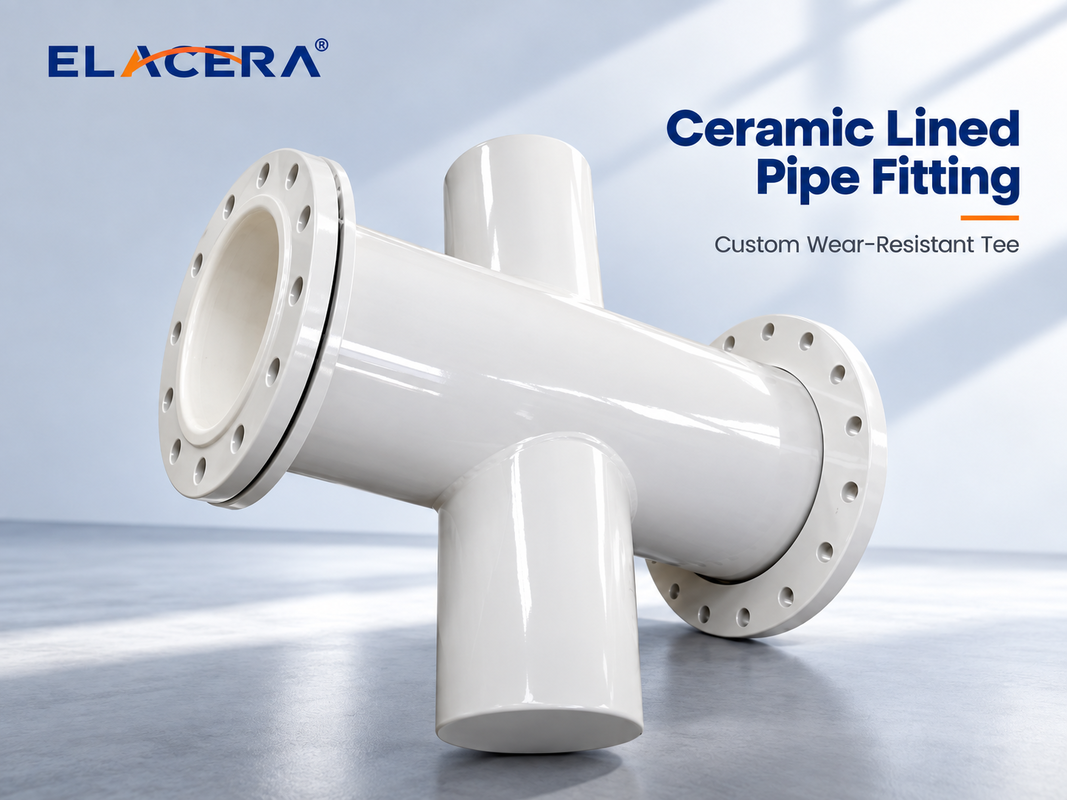
Highlight:
Ceramic Lined Tee Pipe for Abrasive Material Conveying
Product Description
ELACERA ceramic-lined tee pipes use wear-resistant alumina ceramic tiles to protect branch connections and flow-dividing areas exposed to concentrated abrasion and particle impact. We can customize the tee angle, pipe diameter, ceramic thickness, steel structure, and connection type to match project drawings.
A tee is often one of the more difficult sections to protect in an abrasive conveying pipeline.
Unlike a straight pipe, material entering a tee does not follow a single, simple flow path. At the branch area, particles may change direction, strike the junction wall or become concentrated on one side of the fitting. As a result, wear is often highly localized rather than evenly distributed.
For this reason, a ceramic-lined tee should not simply be treated as a straight ceramic pipe with an additional branch.
The ceramic arrangement needs to follow the actual geometry of the fitting and provide continuous protection through the junction.

The Junction Is Usually the Area We Look at First
When abrasive powder, ash, mineral particles, or other bulk material passes through a tee, the branch entrance and the wall opposite the incoming flow can experience repeated particle impact.
The actual wear pattern depends on several factors, including material flow direction, conveying velocity, particle size and hardness, branch angle, solids concentration, and pipe diameter.
This is why two tees with the same nominal diameter may still require different lining designs.
For severe wear positions, thicker ceramic or locally reinforced lining can be considered instead of using exactly the same ceramic thickness throughout the entire fitting.
Ceramic Layout Around the Tee Junction
For a ceramic tile lined tee, the most important part is not simply the ceramic material itself, but how the tiles are arranged around the branch and junction.
The internal surface of a tee changes continuously where the main pipe meets the branch. Ceramic tiles therefore need to be cut and arranged according to the actual internal geometry so that the wear-resistant surface remains as continuous as possible.
Special-shaped or cut ceramic tiles can be used around difficult transition areas.
Where particle impact is expected to be more concentrated, the ceramic thickness can also be adjusted locally according to the operating conditions and approved design.
This gives ceramic tile lining an important advantage for large-diameter and non-standard pipe fittings because the layout can be adapted to complicated internal shapes.
T-Pipe or Y-Pipe?
Not every conveying system requires a conventional 90° tee.
Where the process and installation layout allow it, a Y-shaped branch can provide a smoother change in material direction.
The geometry of a branch affects how particles change direction through the fitting, so the wear distribution inside a 90° tee may be different from that of a Y-pipe.
This does not mean that one branch angle is suitable for every application. Pipe geometry, flow direction, material characteristics, and installation space should be considered together.
ELACERA can manufacture both conventional ceramic-lined tees and customized ceramic-lined Y-pipes according to project drawings.
Typical Construction Options
|
Item
|
Available Options
|
|
Lining material
|
92% / 95% alumina ceramic, ZTA where required
|
|
Lining structure
|
Ceramic tiles, ceramic sleeves/rings
|
|
Steel shell
|
Carbon steel or stainless steel
|
|
Tee configuration
|
90° Tee or customized Y-branch
|
|
Ceramic thickness
|
Selected according to wear conditions
|
|
Connection
|
Flange, welding end, or customized connection
|
|
Pipe size
|
Manufactured according to drawing
|
|
Surface treatment
|
Painting system according to project requirements
|
The steel shell provides structural strength, while the internal alumina ceramic lining protects the material-contact surface against abrasion.
For non-standard tees, ceramic thickness, steel thickness, branch dimensions, and connection details can all be manufactured according to the approved drawing.
Where Ceramic Lined Tees Are Used
Ceramic-lined tee pipes are suitable for pipeline systems conveying abrasive materials such as:
Pulverized coal · fly ash · cement powder · mineral powder · slag · ore fines · sand · tailings and other abrasive bulk materials
Typical applications can be found in cement plants, thermal power stations, mining and mineral processing, steel plants, coal handling systems and other bulk-material conveying installations.
What We Need Before Making a Recommendation
For a standard replacement part, a drawing is usually the fastest way to prepare a quotation.
For a new conveying system or a tee with abnormal wear, it is also helpful to know the:
- Conveyed material
- Particle size
- Flow direction
- Conveying velocity
- Operating temperature
- Existing wear position
- Required service life
These details help us determine whether a standard ceramic lining is sufficient or whether the junction and impact areas require additional protection.
FAQ
Can you manufacture non-standard ceramic lined tees?
Yes. Pipe diameter, branch angle, overall dimensions, ceramic thickness, and connections can be manufactured according to the approved drawing.
Can the branch be made as a Y-pipe instead of a 90° tee?
Yes. Y-shaped ceramic-lined fittings can be customized when required by the pipeline layout and conveying design.
Can the ceramic thickness be different around the tee junction?
Yes. For severe abrasion or concentrated particle impact, ceramic thickness can be adjusted locally according to the wear condition and approved design.
What type of ceramic is normally used?
92% and 95% alumina ceramics are commonly used. ZTA ceramic can also be considered for areas requiring higher impact resistance.
Can you manufacture flanged and welding-end tees?
Yes. Flanged, welding-end, and other customized connection structures are available according to the drawing.
What information should I send for quotation?
A drawing is preferred. If no drawing is available, please provide the pipe diameter, branch angle, connection type, conveyed material and operating conditions.

 Your message must be between 20-3,000 characters!