Highlight:
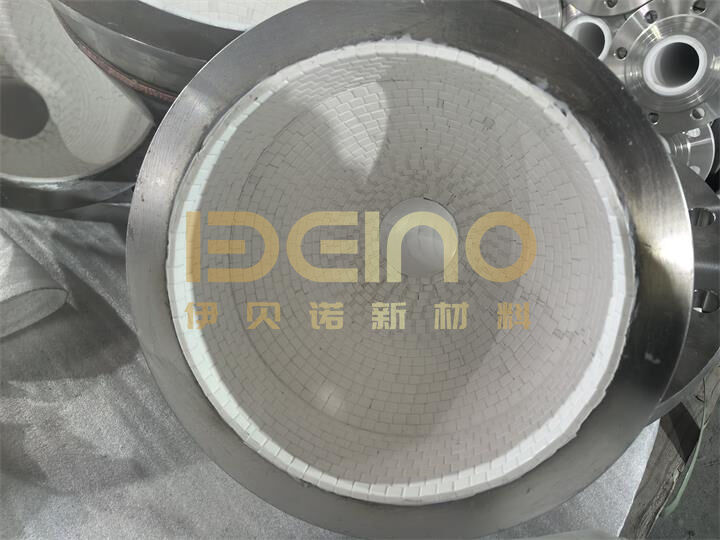
wear-resistant ceramic-lined pipe
, alumina ceramic pipe for coal
, abrasive material conveying pipe
Wear-Resistant Ceramic-Lined Pipe for Coal & Abrasive Material Conveying
Product Description
Wear-Resistant Ceramic-Lined Pipe is designed for severe abrasion environments such as coal powder conveying, pneumatic transport, and bulk material handling. The inner lining is made of high-purity alumina ceramic (Al₂O₃ ≥95%) and sintered at high temperature to provide excellent wear and corrosion resistance and a long service life.
Product Features
Alumina content ≥95%
Rockwell hardness HRA 88–90
Operating temperature up to 350°C
Smooth inner surface, low friction
Lightweight compared to metal liners
Product Advantages
Service life up to 10–20 times longer than steel pipe
Excellent resistance to abrasion, impact, and corrosion
Significantly reduces maintenance and downtime
Cost-effective wear protection solution
Typical Applications
Coal powder conveying pipelines in power plants
Raw material and clinker transport in cement plants
Dust and powder pipelines in steel plants
Slurry and ore conveying in the mining industry
Abrasive chemical material transport
Company Profile
Yibeinuo New Materials focuses on the research and development of new wear-resistant ceramic materials and is committed to providing material transportation, pneumatic conveying system engineering design, and services to various industries, including cement, thermal power, steel, coal, ports, chemicals, new energy, mineral processing, machinery, and other industries. For equipment wear problems under complex working conditions, we have 15 years of industry experience in the field of wear-resistant materials. We provide a one-stop service from production to installation. We can provide product design, research and development, production, and processing services according to customer needs.

Product parameters
| Items |
Specifications |
| Content of alumina |
≥95% |
| Density |
≥3.6 g/cm3 |
| Rockwell A hardness |
≥85HRA |
| Impact strength |
≥1200 MPA |
| Fracture toughness |
≥4.8MPa·m1/2 |
| Bending Strength |
≥350MPa |
| Thermal conductivity |
20W/m.K |
| Thermal expansion coefficient |
7.2×10 6m/m.K |
| Volume wear |
≤0.0002g |
Packaging and Transportation
Packing method: wooden box or steel frame packaging, lined with moisture-proof material to ensure transportation safety.
Transportation method: support sea, air, and land transportation, and provide FOB/CIF/EXW and other trade terms.
Delivery cycle: 25-30 days for conventional products, 30-40 days for customized products.
What Causes Severe Wear in Coal Powder Conveying Pipelines?
Coal powder conveying systems in power plants operate under extremely harsh conditions. Fine coal particles are transported at high velocity through pipelines, causing continuous abrasion, impact, and erosion of the inner pipe wall.
In circulating fluidized bed (CFB) boilers, the situation becomes even more severe due to: Poor coal quality, Large and irregular particle sizes, High conveying speed, Frequent direction changes at the elbows
These factors combined lead to rapid wall thinning, leakage, and unexpected shutdowns.
FAQ
Q: Which Parts of Coal Powder Pipelines Wear the Most?
A: Based on long-term field experience, the most severely worn components include: Pipe elbows, Bends and reducers, Distribution pipes, and high-velocity straight sections. Elbows are particularly vulnerable because coal particles continuously impact the outer wall at high angles, causing accelerated erosion.
Q: Why Do Metal Pipes Fail Quickly in Coal Powder Conveying?
A: Traditional metallic materials such as carbon steel, manganese steel, or high-chromium cast iron rely mainly on thickness to resist wear. However, their hardness is limited, making them ineffective under continuous high-speed abrasion.
Laboratory test data show that alumina ceramic exhibits:
Over 260 times higher wear resistance than manganese steel
More than 170 times higher wear resistance than high chromium cast iron
This explains why metal pipes often require frequent replacement in coal powder systems.
Q: What Is the Best Wear Protection Solution for Coal Powder Pipelines?
A: High-purity alumina ceramic-lined pipes are widely recognized as the most effective solution for coal powder conveying applications. Alumina ceramic offers extremely high hardness, excellent erosion resistance, and outstanding chemical stability.
When properly engineered, ceramic-lined pipes can extend service life by more than 10 times compared to conventional steel pipes.
Q: How Does Offset Ceramic Lining Prevent Ceramic Tile Detachment?
A: One of the key design features for coal powder pipelines is the offset arch ceramic lining structure. Ceramic tiles are bonded to the steel pipe using high-temperature inorganic adhesive and installed in an offset pattern.
This structure:
Eliminates straight-through seams along the flow direction
Prevents coal particles from eroding joints
Significantly reduces the risk of ceramic detachment

 Your message must be between 20-3,000 characters!