Highlight:
ceramic lined battery powder equipment
, metal contamination reduction equipment
, battery powder conveying ceramic lining
How to Reduce Metal Contamination in Battery Powder Conveying
As lithium battery production continues to expand globally, more manufacturers are beginning to realize that powder conveying stability is no longer only an efficiency issue. It is becoming directly connected to product consistency, contamination control, and long-term production reliability.
In many battery material production lines, conveying systems operate continuously for long periods while handling highly abrasive ultra-fine powders such as lithium carbonate, graphite powder, LFP materials, nickel-based cathode materials, and other active battery compounds.
At the early stage of production line design, most attention is usually focused on:
- mixing systems
- coating processes
- calcination equipment
- dust collection systems
- automation control
However, after continuous operation begins, another issue often starts to appear gradually inside the conveying system itself.
Metal contamination caused by equipment wear.
For many battery manufacturers, this problem is far more serious than ordinary mechanical wear.
Because once metallic particles enter sensitive powder materials, the impact may extend beyond equipment maintenance and directly affect product quality consistency.
This is one reason why more lithium battery plants are beginning to re-evaluate traditional metal conveying components.

Why Metal Contamination Is Becoming a Bigger Concern in Battery Material Handling
Unlike ordinary industrial powders, lithium battery materials require extremely strict contamination control.
In many conveying systems, powders continuously pass through:
- rotary valves
- pipelines
- elbows
- cyclones
- feeders
- storage hoppers
During this process, fine particles repeatedly collide with the internal surfaces of conveying equipment at high speed.
Over time, even hardened steel components gradually begin to wear.
In traditional rotary valves, the highest wear areas are usually concentrated around:
- rotor blade edges
- valve chamber walls
- sealing contact surfaces
- discharge ports
As abrasion continues, microscopic metal particles may gradually detach from the equipment surfaces and mix into the powder stream.
At first, this contamination may not be immediately visible.
However, in high-specification battery material production, even extremely small amounts of foreign metallic particles can become a long-term quality risk.
For battery manufacturers, the concern is not only equipment lifespan.
The larger concern is process stability and material purity.
This is especially important in modern lithium battery production lines, where manufacturers are under increasing pressure to improve consistency, reduce defect rates, and maintain tighter quality control standards.
Why Traditional Metal Rotary Valves Often Become the Weak Point
Many battery plants initially use standard stainless steel rotary valves because they are relatively common and easy to source.
In low-abrasion industries, these valves may operate adequately for long periods.
However, battery powder conveying environments create a very different operating condition.
Ultra-fine powders behave differently from ordinary bulk materials.
Some battery materials not only create continuous abrasion, but also easily accumulate inside narrow clearances and sealing areas.
As internal wear gradually increases, several operational problems often begin to appear simultaneously:
- unstable sealing performance
- powder leakage
- increased internal clearance
- material accumulation
- inconsistent feeding
- higher contamination risk
In many cases, maintenance teams initially focus only on replacing worn parts.
But after repeated maintenance cycles, they gradually realize that the issue is not isolated wear itself.
The real issue is that the entire conveying system requires a more stable, long-term wear-resistant structure.
This is why more battery manufacturers are moving away from conventional metal contact surfaces in critical conveying areas.
Why Ceramic Lined Rotary Valves Are Becoming More Common in Battery Plants
Over the past few years, ceramic-lined conveying components have become increasingly common in lithium battery production facilities.
One of the main reasons is the material characteristics of alumina ceramic itself.
Compared with ordinary metal materials, high-purity alumina ceramic offers:
extremely high hardness
excellent abrasion resistance
corrosion resistance
smoother internal surfaces
lower risk of metallic wear contamination
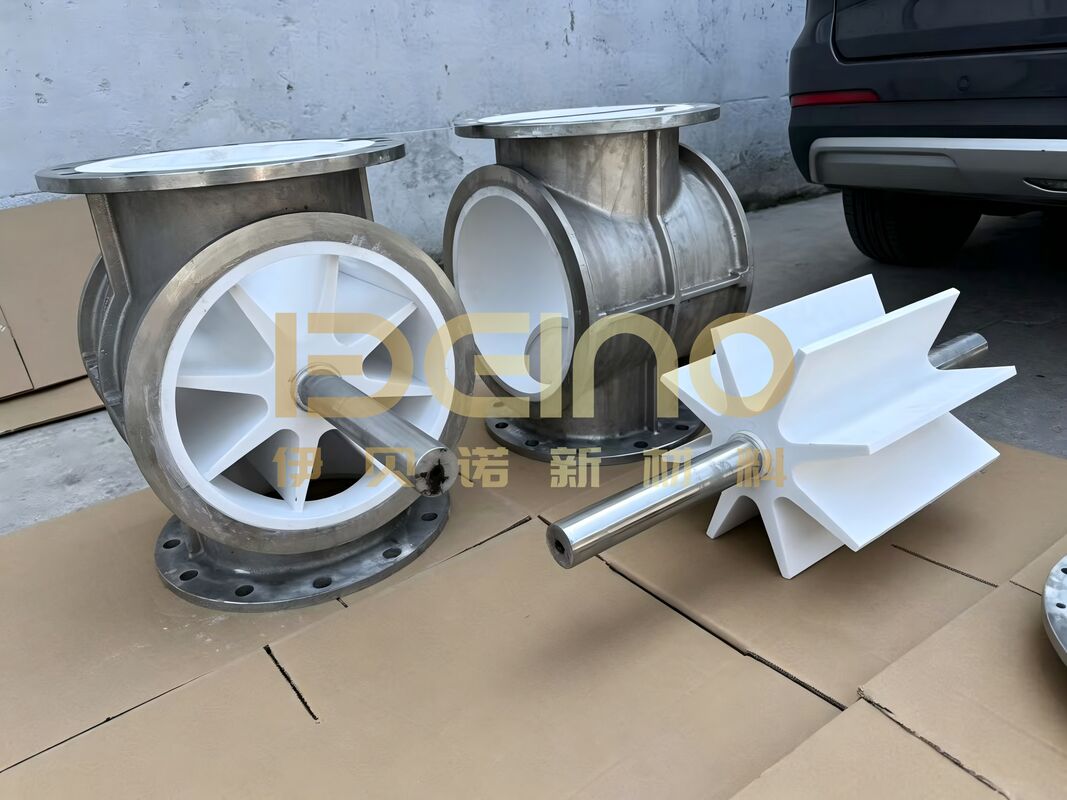
In rotary valve applications, ceramic lining is typically used to protect the major wear zones directly exposed to continuous powder flow.
These areas may include:
- rotor surfaces
- valve chambers
- flow passages
- sealing areas
The purpose is not simply to extend equipment lifespan.
More importantly, it is to improve long-term conveying stability while reducing the possibility of internal metallic wear entering the powder system.
For battery material conveying, the smooth ceramic surface also helps reduce powder buildup and minimizes material retention inside the valve chamber.
This becomes particularly important when handling ultra-fine powders that are sensitive to flow consistency and contamination control.
Stable Conveying Is Becoming More Important Than Initial Equipment Cost
In the past, many purchasing decisions focused mainly on initial procurement cost.
Today, more battery manufacturers are evaluating conveying systems differently.
Instead of asking only:
“How much does the equipment cost?”
More engineering and procurement teams are beginning to ask:
How stable will the system remain after long-term operation?
- How often will maintenance be required?
- Can contamination risks be reduced?
- Will powder leakage become a problem over time?
- Can the conveying system maintain stable feeding accuracy?
This shift is becoming increasingly important as battery production scales continue expanding worldwide.
In high-capacity production environments, even short maintenance interruptions may affect:
- production scheduling
- powder consistency
- equipment cleaning workload
- labor efficiency
- operating cost control
For this reason, many manufacturers are no longer treating rotary valves as simple auxiliary devices.
They are increasingly viewed as part of the overall process reliability system.
Why More Battery Plants Are Investing in Long-Term Reliability
As lithium battery manufacturing standards continue to rise, equipment selection is gradually shifting from short-term purchasing logic toward long-term operational reliability.
Many factories have already realized that reducing maintenance frequency and improving conveying stability can often create greater long-term value than simply reducing initial equipment cost.
This is one reason ceramic-lined rotary valves, ceramic conveying pipelines, and ceramic wear-resistant components are becoming increasingly common in battery material-handling systems.
Because in modern battery manufacturing, stable conveying is no longer only about moving powder from one point to another.
It is closely connected to contamination control, production consistency, operational efficiency, and long-term process stability.

 Your message must be between 20-3,000 characters!