Highlight:
Flexible Ceramic Lined Hose
, Power Plants Ceramic Lined Hose
Flexible Ceramic Lined Hose For Fly Ash Conveying In Power Plants
Product introduction
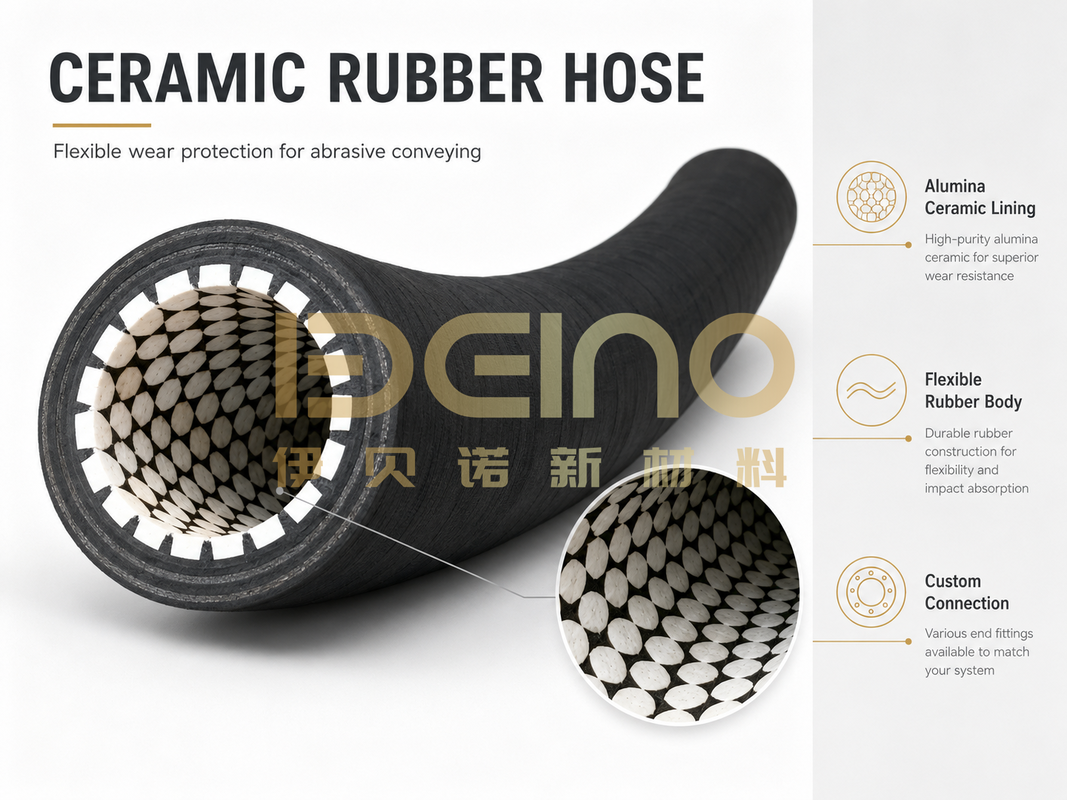
Elacera flexible ceramic-lined hose is used at vibration-prone or misaligned connections in power plant fly ash systems. High-alumina ceramic protects the internal flow surface from abrasive ash, while the reinforced rubber body provides controlled flexibility between equipment and fixed pipework. Each hose is selected from the temperature and pressure measured at its actual installation point.
For a fly ash connection, the first question should not be, “How hard is the ceramic?” It should be, “What temperature reaches this exact point?” The ceramic may tolerate heat, but a flexible hose is a complete assembly of ceramic, rubber, reinforcement, and bonding materials. The safe operating limit belongs to the assembly, not to the ceramic alone.
Elacera flexible ceramic-lined hose is intended for ash-system connections where an ordinary rubber hose wears rapidly, but a rigid pipe cannot accommodate normal vibration, installation offset, or limited movement. Alumina ceramic segments protect the flow path, and the reinforced rubber body maintains flexibility at a defined bend radius.

Start with the Installation Point
Fly ash systems are not at one uniform temperature. A connection near a hot ash source may experience very different conditions than at a downstream transfer point. Ask the plant for both the normal temperature and the highest temperature recorded during upset conditions at the proposed hose location.
The standard product range on this page is used up to 100°C, subject to rubber selection and the final hose design. If the actual temperature can exceed that limit, a ceramic-lined steel spool or a separately engineered high-temperature connection is the safer starting point.
Before Replacing Another Rubber Hose, Check These Four Causes
1. Flow direction. An elbow or reducer immediately upstream can direct ash toward one side of the hose.
2. Conveying velocity. Fine ash still causes severe sliding abrasion when air velocity is unnecessarily high.
3. Installed shape. Over-bending or local collapse reduces the flow area and concentrates wear.
4. Movement. Pressure pulsation, poor support, or flange misalignment can make the hose move repeatedly during operation.
Ceramic lining addresses the wear surface; it does not hide these system problems. The most reliable replacement combines the right hose with corrected routing and support.
Choosing the Connection, Not Just the Material
|
Connection type
|
Best used where
|
Main limitation
|
|
Ordinary rubber hose
|
Flexibility is needed, and abrasion is low
|
Rubber bore remains exposed to fly ash
|
|
Ceramic-lined steel pipe
|
The section is fixed, aligned, and severely abrasive
|
Cannot absorb movement
|
|
Flexible ceramic-lined hose
|
Abrasion and controlled movement occur together
|
Must stay within rated temperature, pressure and bend radius
|
A well-designed ash line may use all three. Flexible ceramic hose adds the most value at a specific troublesome connection, not simply at the longest section of pipe.
Technical Reference for Selection
|
Parameter
|
Typical specification
|
|
Internal lining
|
95% alumina ceramic segments
|
|
Typical ceramic density
|
Approximately 3.75 g/cm³
|
|
Rockwell hardness
|
≥85 HRA
|
|
Compressive strength
|
≥850 MPa
|
|
Working pressure
|
1.0–2.5 MPa, depending on ID and reinforcement
|
|
Operating temperature
|
Up to 100°C, subject to complete hose design
|
|
Length
|
Customized; practical range depends on hose size and handling
|
|
Connections
|
Custom flanges or specified end fittings
|
|
Electrical requirement
|
Available only when specified and verified in the hose design
|
Information an Ash-System Buyer Should Send
A useful RFQ describes the duty at the connection. Include the ash type, normal and maximum temperature, conveying pressure, pressure fluctuation, hose ID, required length, installed curve, and flange drawing. If the plant has grounding, electrical continuity, or flame-resistance requirements, state them as separate technical items rather than assuming they are standard.
Also send photographs of the failed hose. A hole near the inlet, one-sided wear, cracking at the flange, and general thinning of the bore point are different causes and may lead to different recommendations.
Installation Notes for Fly Ash Service
· Keep the hose above the approved minimum bend radius.
· Align flanges before tightening; do not use the hose to pull pipework into place.
· Support the hose weight without preventing its intended movement.
· Avoid a protruding gasket or abrupt internal step at the inlet.
· Inspect unusual movement, cover damage, and flange leakage during routine maintenance.
Manufacturing and Inspection
The ceramic arrangement, reinforcement, and end connections are made to the approved hose drawing. Dimensional and flange checks are completed before delivery, and visible ceramic condition is inspected from the accessible ends. When the purchase specification calls for a pressure test or inspection record, the requirement is agreed before production.
Hunan Yibeinuo New Material Co., Ltd. supplies Elacera ceramic-lined products for ash transport pipelines, bends and flexible equipment connections. This allows the wear solution to be selected by location instead of forcing one product type across the complete line.
Frequently Asked Questions
Can this hose be installed close to a hot ash outlet?
Only if the measured normal and upset temperatures remain within the rating of the complete hose. Ceramic temperature resistance alone is not enough.
Does a thicker rubber hose solve fly ash wear?
It may delay failure, but the rubber remains the wear surface. Repeated failure at the same connection is a reason to review ceramic lining and the upstream flow path.
Can the hose absorb vibration?
It can accommodate normal movement within the approved design. It should not be used to correct severe misalignment or uncontrolled pipe movement.
Is anti-static performance included?
Not automatically. Any electrical continuity, grounding or anti-static requirement must be specified and verified for the supplied construction.
What should appear on the approved drawing?
Hose ID, overall length, flange details, pressure rating, temperature rating, minimum bend radius and any special reinforcement or electrical requirement.
If your fly ash hose fails repeatedly, send Elacera the operating temperature at that connection, a routing photograph, and the existing hose specification. We will review the wear point before recommending the replacement structure.

 Your message must be between 20-3,000 characters!