Highlight:
Flexible Ceramic Lined Hose for Cement Powder Conveying
Product introduction
Flexible connections are often the first parts to wear out in a cement powder conveying line. This is especially common below silos, beside rotary valves and screw conveyors, or between fixed pipework and vibrating equipment.
A conventional rubber hose can absorb vibration and limited movement, but its inner rubber layer remains exposed to the powder flow. Fine cement particles gradually erode the same area, making the hose thinner and increasing the risk of leakage or unexpected shutdown.
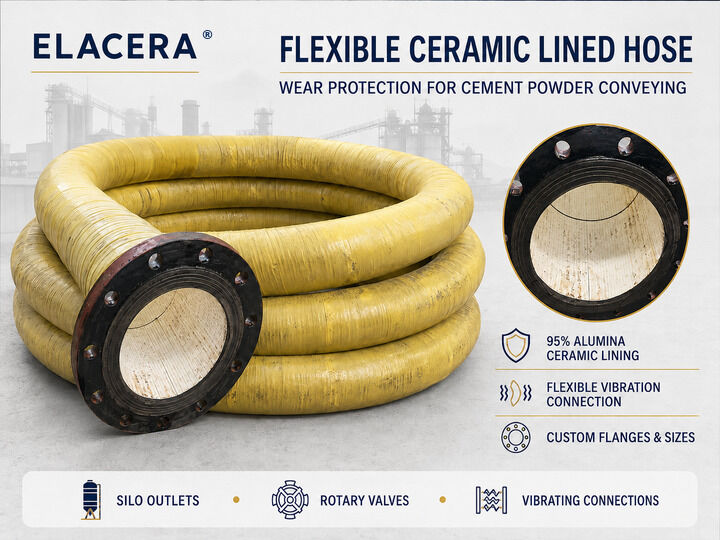
The Elacera flexible ceramic-lined hose is designed for repeated-wear connections in cement powder conveying systems. Its alumina ceramic lining receives most of the direct abrasion, while the reinforced rubber body retains the controlled flexibility required at moving or vibrating connections.
Why Flexible Connections Wear So Quickly
A rigid ceramic-lined steel pipe performs well in fixed conveying sections, but it cannot replace every flexible joint in a cement plant. Some connections must compensate for equipment vibration, small installation deviations, or limited movement during operation.
These short hose sections can become points of concentrated wear. Abrasion is often more severe near discharge outlets, bends, or areas where the material flow changes direction. Once the inner rubber is worn through, powder leakage may occur even though the surrounding steel pipework remains in good condition.
Installing a ceramic-lined hose at these positions moves the main wear surface from the rubber body to the ceramic lining. This helps reduce the risk of premature leakage without converting the flexible connection into a rigid assembly.

Typical Installation Positions
The hose can be considered for:
- Connections below cement silos and storage bins
- Flexible joints near rotary valves and screw conveyors
- Cement powder loading and unloading lines
- Connections between fixed pipelines and vibrating equipment
- Cooled raw meal and dry mineral powder conveying systems
- Short hose sections that have already been replaced repeatedly because of internal abrasion
The product is intended mainly for dry, cooled abrasive powder. If the conveyed material is hot, the continuous and peak temperatures must be confirmed before the rubber compound, bonding system, and complete hose construction are selected.
Ceramic Lining and Hose Construction
Closely arranged alumina ceramic pieces form the wear-resistant inner surface. They are embedded and securely fixed within the rubber structure, allowing the hose to bend within its designed range while limiting direct contact between the conveyed powder and the inner rubber layer.
A typical construction includes:
- 95% alumina ceramic wear lining
- Elastic rubber cushioning layer
- Reinforcement layers selected according to hose diameter and pressure
- Protective outer rubber cover
- Customized flanges or project-specific end fittings
The ceramic arrangement, reinforcement structure, and end connections are not identical for every hose. They are selected according to the inner diameter, total length, working pressure, installation position, and required bending performance.
The hose must not be bent below its confirmed minimum bending radius. Excessive bending or twisting may place unnecessary stress on the ceramic lining and end connections.
Practical Benefits at Repeated-Wear Positions
Ceramic Protection Against Cement Powder
The alumina ceramic lining receives most of the direct impact and sliding abrasion from the powder flow. This protects the rubber body in areas where an ordinary hose may wear through too quickly.
Controlled Flexibility
The ceramic pieces work together with the rubber body, allowing the hose to accommodate normal equipment vibration and limited movement. It remains a flexible component, but its bending range must follow the confirmed hose design.
Connections Made to Match the Pipeline
Flange dimensions, bolt-hole patterns, and other end fittings can be produced according to the existing pipeline, flange standard, or project drawing. This can reduce modification work during installation.
Maintenance Focused on a Short Section
When wear is concentrated at one flexible connection, a correctly designed hose can be removed and replaced without changing a long section of fixed pipework.
Better Suited to Known Wear Points
A ceramic-lined hose is particularly useful where previous rubber hoses have already shown repeated internal wear. For low-abrasion service, a conventional rubber hose may still be the more economical choice.
Reference Technical Data
|
Item
|
Reference Specification
|
|
Product Type
|
Flexible Ceramic Lined Rubber Hose
|
|
Ceramic Material
|
95% Alumina Ceramic
|
|
Ceramic Density
|
Approx. 3.75 g/cm³
|
|
Ceramic Hardness
|
≥85 HRA
|
|
Hose Construction
|
Alumina Ceramic Lining + Reinforced Rubber Hose Body
|
|
Suitable Materials
|
Cement Powder, Cooled Raw Meal and Other Dry Mineral Powders
|
|
Working Pressure
|
Confirmed according to hose ID, reinforcement, and operating conditions
|
|
Operating Temperature
|
Confirmed according to material temperature, rubber compound, and hose design
|
|
Inner Diameter
|
Customized
|
|
Hose Length
|
Customized
|
|
End Connections
|
Custom Flanges or Project-Specific Fittings
|
|
Minimum Bending Radius
|
Confirmed according to hose dimensions and construction
|
The information above is a general reference rather than a fixed specification for every hose. Final pressure, temperature, and bending limits must be confirmed according to the complete hose construction and actual operating conditions.
Information Needed Before Quotation
Inner diameter alone is not enough to select a ceramic-lined hose. For quotation and structure confirmation, please provide:
- Conveyed material
- Required inner diameter
- Hose length
- Working and peak pressure
- Continuous and peak material temperature
- Required bending radius
- Flange standard or connection drawing
- Installation drawing or clear site photographs
- Whether the hose is subject to vibration, movement or negative pressure
- Required quantity
These details help determine whether a ceramic-lined hose is suitable for the installation and allow us to review the ceramic layout, reinforcement structure and end connection design.
Inspection and Export Packing
Before delivery, the hose dimensions, flange connections, visible ceramic lining and external appearance are checked against the confirmed drawing or order requirements.
Flange faces are protected during transportation. Depending on the hose dimensions and order quantity, the products can be packed in reinforced wooden cases or on suitable export pallets. Shipping marks and documents can be prepared according to the order requirements.
FAQ
Is this hose suitable for hot cement powder?
It depends on the continuous and peak material temperatures. Temperature affects the rubber compound, bonding system and expected service performance. The actual operating temperature must be confirmed before production.
Can it replace every rubber hose in a cement plant?
No. It is most useful where internal abrasion is the main cause of repeated hose failure. A conventional rubber hose may still be sufficient and more economical for low-wear service.
Does the ceramic lining make the hose rigid?
No. The ceramic pieces are arranged within the rubber body so that the hose retains controlled flexibility. However, it cannot be bent or twisted without limitation and must not operate below the confirmed minimum bending radius.
Can the hose withstand negative pressure?
Negative pressure or suction conditions must be specified before design. The reinforcement structure may need to be adjusted to reduce the risk of hose collapse.
Can the flange dimensions match an existing pipeline?
Yes. Flanges and other end fittings can be customized according to a drawing, flange standard, or verified installation dimensions.
How is the allowable working pressure determined?
It depends on the hose inner diameter, reinforcement structure, total length, end fittings, and actual operating conditions. The pressure rating must be confirmed for each design rather than assumed from the product name.
What information is most important for a quotation?
Please provide the inner diameter, length, conveyed material, working pressure, operating temperature, flange details, and quantity. An installation drawing or clear photograph of the existing connection is also helpful.
About Elacera
Hunan Yibeinuo New Material Co., Ltd. supplies wear-resistant ceramic products and ceramic lined components for abrasive material handling systems. Under the Elacera brand, we provide ceramic-lined pipes, flexible ceramic-lined hoses, rubber-ceramic liners, ceramic pulley lagging, and customized wear-protection components.
For a quotation or technical review, please send us the hose dimensions, operating conditions, and connection drawing. We will review the actual wear position and recommend a suitable ceramic lining, reinforcement structure and end connection.

 Your message must be between 20-3,000 characters!