Highlight:
Ceramic Ring Lined Elbow with Loose Flanges for Abrasive Powder Conveying
A Wear-Resistant Elbow That Also Needs to Fit the Pipeline
When replacing a worn pneumatic conveying elbow, ceramic hardness is only one part of the purchasing decision.
The replacement must fit between existing pipe sections, match the required bend radius, and connect correctly to the mating flanges. Even a well-manufactured ceramic-lined elbow can create installation difficulties if its finished bore, flange dimensions, or bolt-hole orientation have not been checked.
An ELACERA ceramic ring-lined elbow with loose flanges brings these requirements together in one assembly. It combines a wear-resistant alumina ceramic inner lining with a steel outer shell and loose flange connections, offering a practical configuration for abrasive powder conveying pipelines.
Unlike an ordinary ceramic tile-lined elbow, the internal wear surface is formed by ceramic ring sections rather than individually arranged ceramic tiles.
This difference in lining construction is worth understanding before selecting a replacement bend.
Why Choose Ceramic Ring Lining Instead of Ceramic Tiles?
A ceramic ring, also called a ceramic sleeve, forms a complete circumferential lining section inside the steel pipe.
In a ceramic sleeve-lined elbow, specially dimensioned ceramic sections are arranged to follow the required bend geometry. Each section provides a continuous ceramic surface around the pipe circumference, while joints remain between adjacent sections.

This structure has several characteristics:
- Fewer longitudinal lining joints: Each complete ceramic ring avoids the lengthwise joints found between individual ceramic tiles within the same section.
- Defined internal geometry: The ring bore can be manufactured to specified dimensions, helping control the finished flow passage.
- Full-circumference coverage: The ceramic protects the internal surface around the pipe, rather than only a selected wear zone.
- Drawing-based construction: Ring dimensions, joint arrangement, and the steel bend must be considered together.
Ceramic rings do not eliminate all lining joints. On a curved pipe, the transitions between adjacent sections require careful dimensional control to avoid unwanted internal steps or exposed edges.
They are also not automatically superior to ceramic tiles.
For complex bends, unusual internal shapes or designs requiring different lining thicknesses in selected wear zones, custom ceramic tiles may offer greater flexibility.
The appropriate choice depends on the geometry, conveyed material, operating conditions, and manufacturing feasibility.
Why Loose Flanges Matter in a Replacement Elbow
A conventional fixed flange has a defined bolt-hole orientation relative to the pipe body.
This can become inconvenient when replacing an elbow in an existing installation, particularly where the adjacent pipe sections cannot easily be rotated.
With a correctly designed loose flange arrangement, the flange can rotate independently of the elbow body. This allows its bolt holes to be positioned to match the mating connection during installation.
For maintenance and replacement work, this may reduce the need to rotate the entire elbow solely to align the bolts.
However, loose flanges do not correct an incorrectly manufactured pipe.
The bolt circle, flange dimensions, sealing arrangement, end-to-end geometry, and installation space must still match the existing system. The flange and pipe-end retention arrangement must also be suitable for the specified operating pressure and mechanical loads.
A loose flange improves connection flexibility; it does not replace dimensional accuracy.
This is why we recommend confirming the complete flange assembly instead of specifying only the nominal pipe diameter.
Example: DN80 Ceramic Ring Lined Elbow
A representative ELACERA configuration uses 95% alumina ceramic ring lining inside a steel elbow with loose flange connections.
|
Item
|
Reference Configuration
|
|
Product
|
Ceramic Ring Lined Elbow
|
|
Nominal Diameter
|
DN80
|
|
Bend Angle
|
90°
|
|
Bend Radius
|
R500 mm
|
|
Ceramic Material
|
95% Alumina (Al₂O₃)
|
|
Lining Construction
|
Segmented Ceramic Rings
|
|
Outer Structure
|
Steel Shell
|
|
End Connections
|
Loose Flanges at Both Ends
|
|
Flange Reference
|
DIN 2642, as specified in the reference drawing
|
These dimensions describe an existing reference configuration. Other sizes, bend geometries, and flange arrangements require drawing review and manufacturing confirmation.
For a similar replacement, the nominal diameter alone is not sufficient.
The finished internal diameter after ceramic lining, centerline radius, flange dimensions, and face-to-face geometry need to be agreed before production.
This is particularly important when the new elbow is connected to pipework with a different lining thickness or internal bore.
Three Installation Details Buyers Should Not Overlook
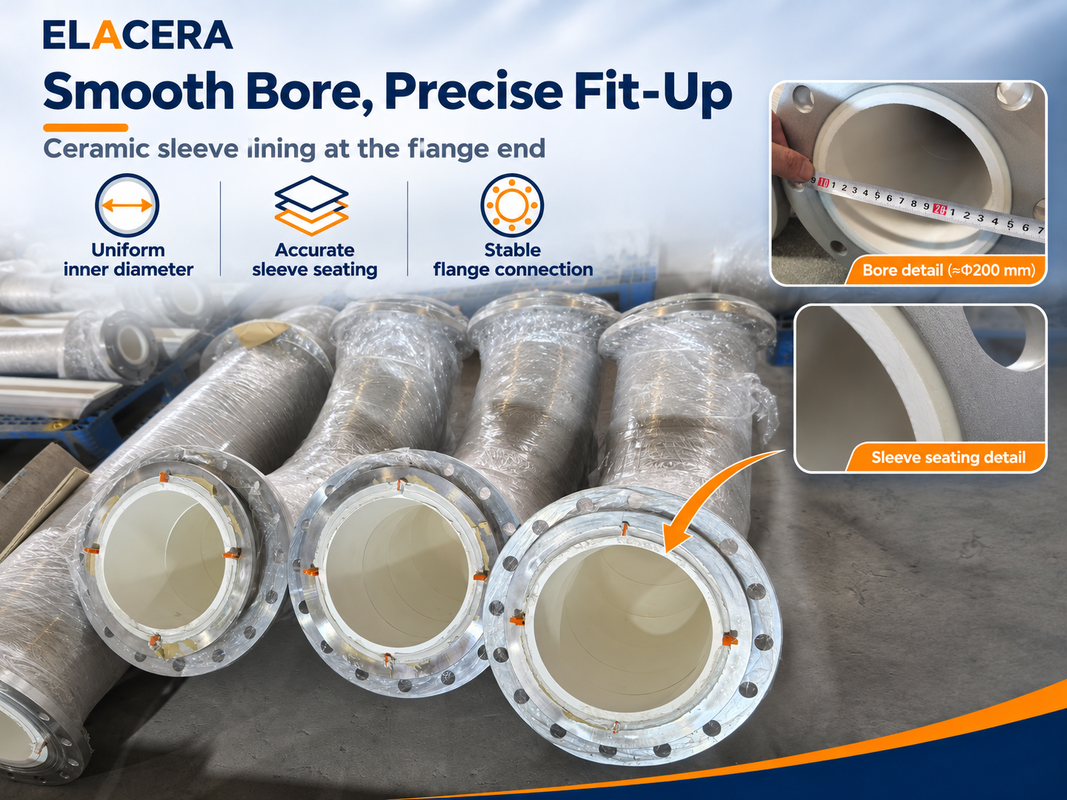
1. Ceramic Transition at the Flange End
The ceramic lining must terminate at the correct position relative to the pipe end and connection.
An unsuitable termination can leave an exposed metal area, a raised ceramic edge or an abrupt change in the internal flow passage.
Before manufacturing, the drawing should identify the finished bore and how the lining meets the connecting pipe.
2. Alignment Between Ceramic Ring Sections
The ceramic rings must be positioned to maintain an appropriate internal profile along the bend.
Misaligned sections can create local steps at the joints. These steps may change particle contact conditions and create concentrated wear or impact at exposed edges.
For this reason, ring dimensions, joint fit, and internal alignment deserve particular attention during manufacture and inspection.
3. Flange and Pipework Compatibility
Loose flanges provide rotational adjustment for bolt-hole alignment, but the complete connection must still be compatible.
Check the flange standard, bolt pattern, sealing faces, gasket requirements, and pipe support arrangement.
An elbow that fits the flange bolts but does not match the intended pipeline geometry is not an acceptable replacement.
Where Can This Elbow Be Used?
Alumina ceramic ring-lined elbows may be considered in dry abrasive powder conveying systems, including:
- Fly ash conveying lines in power generation
- Cement and mineral powder transportation
- Pulverized coal and industrial dust conveying
- Abrasive powder distribution pipework
- Selected replacement sections in pneumatic conveying systems
The actual application should be evaluated against particle characteristics, conveying velocity, temperature, operating pressure, and the existing pipeline design.
Where substantial particle impact occurs, ceramic material, section geometry, and lining retention should be reviewed rather than relying on alumina content alone.
What Should You Send for a Custom Quotation?
For a custom ceramic ring-lined pipe bend, the most useful information is an engineering drawing of the complete replacement assembly.
If a drawing is unavailable, photographs and measurements of the existing elbow can provide a starting point.
Please include the nominal diameter, required finished bore, bend angle, centerline radius, flange standard, and connection details.
We also recommend identifying the conveyed material, approximate particle size, operating temperature, pressure, and any known wear or maintenance problems.
With this information, ELACERA can review the proposed ring lining structure, steel shell, loose flange arrangement, and dimensional requirements before preparing a quotation.
Ceramic Ring or Ceramic Tile: Which Should You Request?
If the main requirement is a dimensionally defined elbow with circumferential ceramic ring sections, a ceramic ring-lined elbow is worth evaluating.
If the pipe geometry is particularly complex or requires a specialized tile layout, a ceramic tile-lined elbow may be more practical.
Don't choose a lining method based on the product name alone.
Choose the solution that best fits the actual wear mechanism, pipeline geometry, and installation requirements.
Request Your Ceramic Ring Lined Elbow Quotation
ELACERA supplies customized wear-resistant ceramic-lined pipes and fittings for industrial material conveying systems.
Send us your elbow drawing or the dimensions of the existing pipe section. We can review the ceramic lining method, flange arrangement and manufacturing requirements for your application.
Email: Amy@ybnceramic.com
Website: www.ybnceramic.com
Related Product: Wear Resistant Ceramic Sleeve for Steel Pipe with Alumina Ceramic Ring Lining

 Your message must be between 20-3,000 characters!