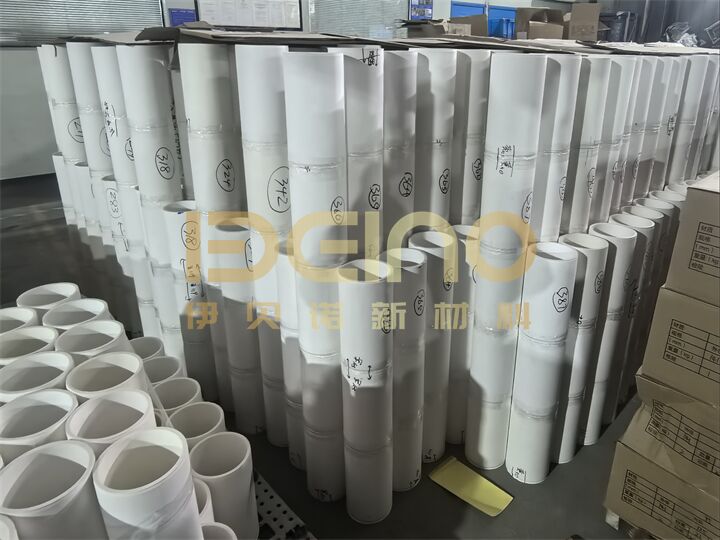
Highlight:
wear resistant ceramic lined pipe
, alumina ceramic powder conveying pipe
, ceramic lined pipe for powder transport
Wear Resistant Ceramic Lined Pipe for Powder Conveying
Product description
The wear-resistant ceramic-lined pipe is engineered for high-abrasion powder and bulk material conveying systems. The inner wall is lined with high-density 95% alumina ceramic, which effectively protects the steel pipe from erosion caused by high-speed airflow and solid particle impact.
Compared with traditional steel pipelines, the ceramic-lined pipe significantly improves service life and reduces maintenance frequency. It is particularly suitable for pneumatic conveying systems in cement plants, steel mills, lithium battery production lines, and mining operations.
Product Design
Three-layer composite design
Outer steel pipe for structural strength
High-strength adhesive bonding layer
High-density alumina ceramic lining

Product parameters
| Items |
Specifications |
| Al2O3% |
≥92% |
| Fe2O3% |
≤0.20% |
| Mohs' hardness |
9 |
| Water Absorption (%) |
≤0.02 |
| Density(g/cm3) |
≥3.60 |
| Abrasion(%) |
≤0.02 |
Products Feature
The process of welding ceramic lining pipelines is mainly to solve the problem of wear of conveying system equipment under high temperature pneumatic force. It has the characteristics of super wear resistance, high temperature resistance, good toughness, strong impact resistance, and stud welding does not fall off.
Production workshop introduction
The company has strong product development and production capabilities, with advanced wear resistant ceramic production lines, isostatic pressing, automatic presses, spray drying towers, etc., as well as steel structure production lines, medium frequency hot simmering pipe benders and other large scale equipment, and are equipped with professional Equipment and technicians, welded ceramic lining pipes adopt a one piece forming seamless pipe process.
Why Do Elbows Wear Out So Fast?
In most pneumatic conveying systems, elbows are the first components to fail. When powder or bulk materials change direction, high-speed particles directly impact the outer wall of the elbow, causing severe wear. Many plants replace steel elbows every 2–3 months, leading to frequent shutdowns and high maintenance costs.
How can we reduce elbow replacement frequency?
Frequent elbow replacement is usually caused by high-speed particle impact and severe abrasion. Installing a ceramic-lined elbow or using an alumina ceramic sleeve at high-wear positions can significantly improve wear resistance. The high hardness of alumina ceramic effectively protects the steel structure, extending service life by 3–5 times. This reduces shutdown time and spare part consumption.
How can we lower maintenance costs?
Maintenance costs mainly come from frequent pipe replacement and labor downtime. Using abrasion-resistant ceramic pipe or ceramic composite pipe greatly reduces wear and prolongs replacement cycles. Although the initial cost is higher than that of steel pipes, the long-term savings in labor, spare parts, and downtime make ceramic-lined pipelines more economical.
How can we avoid a production shutdown?
Production shutdown often occurs due to pipeline leakage or sudden failure. Installing alumina ceramic-lined pipe in critical sections ensures stable operation. The ceramic liner protects against wear-through, preventing unexpected breakdowns. This improves operational reliability and keeps production running continuously.
How can we improve conveying efficiency?
Ceramic-lined pipelines have smoother inner surfaces compared with worn steel pipes. Reduced friction improves material flow and lowers resistance. This allows higher conveying capacity and more stable material transport, especially for powder and granular materials.
How can we prevent material contamination?
Steel pipes may rust or generate metal particles after long-term wear. Alumina ceramic liner is chemically stable and corrosion-resistant. It prevents contamination and ensures material purity, which is especially important for power plants, cement, and chemical industries.
How can we extend pipeline service life?
Using 95% alumina ceramic liner inside pipes forms a high-hardness protective layer. This structure resists abrasion, erosion, and impact. Compared with conventional steel pipes, service life can be extended several times, reducing total lifecycle cost.

 Your message must be between 20-3,000 characters!