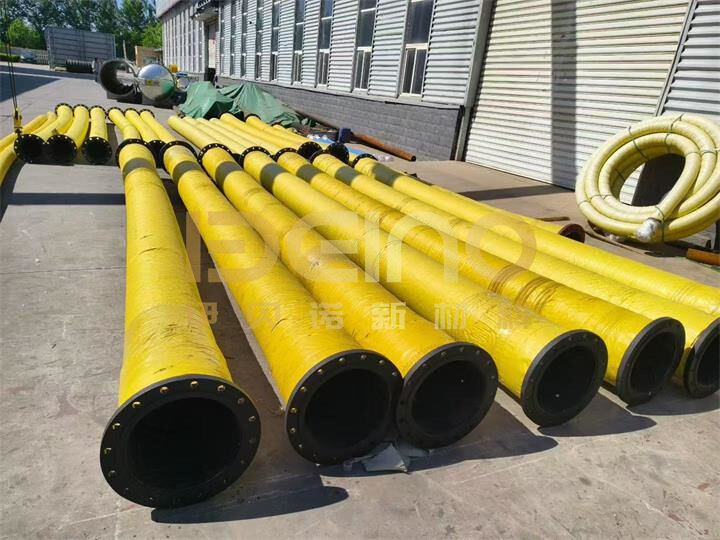
Highlight:
ceramic embedded rubber hose
, rubber hose with ceramic liner
, ceramic lined rubber hose
Extend Hose Life and Reduce Maintenance Costs with Our Ceramic Embedded Rubber Hose
In industrial operations, whether in mining, cement, power, or steel plants, conveying abrasive materials often creates one of the most persistent maintenance challenges: hose wear and premature failure. Traditional rubber hoses wear out quickly under abrasive slurries, powders, and granular materials, leading to frequent replacements, unplanned downtime, and rising maintenance costs.
At our company, we don't simply supply hoses—we help industrial plants solve wear problems.
Our ceramic-embedded rubber hose was developed for applications where conventional rubber hoses fail repeatedly due to abrasive slurries, powders, and granular materials.
By combining high-purity alumina ceramic (Al₂O₃ ≥ 95%) with flexible nitrile rubber, the hose delivers outstanding wear resistance while maintaining the flexibility required for complex conveying systems.
Designed for Severe Industrial Applications
Our hoses are engineered for the most demanding applications
Mining: Iron ore, copper concentrate, gold tailings, and slurry transfer
Cement & Power Plants: Fly ash, clinker, coal powder, and pneumatic powder transfer
Steel Industry: Blast furnace dust, pulverized coal, and abrasive material handling
Port Handling & Bulk Material Transfer: Sand, gravel, and loading/unloading applications
By targeting industries with high abrasion and complex conveying systems, our hoses help plants minimize maintenance interruptions and ensure continuous production.

Alumina ceramic technical parameters
|
Parameter
|
Specification
|
Value Highlight
|
|
Inner Diameter (DN)
|
25 – 300 mm
|
Fits most plant piping systems
|
|
Length (L)
|
Up to 10 m
|
Customizable for specific layouts
|
|
Working Pressure
|
1.0 – 2.5 MPa
|
Handles high-pressure conveying
|
|
Operating Temperature
|
≤ 100°C
|
Suitable for hot material transfer
|
|
Alumina Content
|
≥ 95%
|
Exceptional wear resistance
|
|
Hardness (Rockwell)
|
≥ 85 HRA
|
High surface durability
|
|
Compressive Strength
|
≥ 850 MPa
|
Resists material impact
|
|
Bending Strength
|
≥ 290 MPa
|
Maintains integrity under bending
|
How It Solves Your Hose Wear Problem
Combat Abrasion Effectively: High-purity alumina ceramic tiles are precision-embedded into the inner wall of the hose. These tiles act as a durable barrier, absorbing the impact of abrasive particles while maintaining smooth flow. This design dramatically reduces internal wear, especially at elbows, bends, and high-velocity sections where standard hoses fail first.
Maintain Flexibility: Unlike rigid steel pipes, the surrounding nitrile rubber structure ensures flexibility, impact absorption, and vibration damping. The hexagonal arrangement of ceramic tiles allows large-angle bending without detachment, making installation easier in confined spaces and complex layouts.
Reduce Maintenance Costs and Downtime: Extended hose life means fewer replacements, less labor, and reduced spare parts inventory. This translates directly into lower total operating costs, improved workflow efficiency, and safer operations in handling abrasive or corrosive materials.
Customizable for Your Needs: We offer hoses with inner diameters from 25–300 mm, lengths up to 10 meters, and a variety of connection options, including flanges, threaded couplers, and quick connectors. Special configurations can be tailored to specific plant requirements for optimal performance.
Proven Value Across Industries
By adopting our ceramic embedded rubber hoses, plants have realized:
Up to 70% reduction in hose replacement frequency
Lower pumping energy consumption due to smooth inner surfaces
Safer operation with reinforced steel wire, preventing bursting
Reduced unplanned shutdowns, protecting production schedules
This combination of durability, flexibility, and operational reliability ensures that your conveying system performs efficiently and safely, protecting both your equipment and your bottom line.
FAQ
How long does a ceramic-embedded rubber hose last compared with a standard rubber hose?
The service life depends on the material being conveyed, operating pressure, and flow velocity. In most abrasive applications, such as fly ash, cement powder, mining slurry, and mineral concentrate transfer, ceramic-embedded rubber hoses typically last 3 to 10 times longer than conventional rubber hoses.
What materials are suitable for ceramic-embedded rubber hoses?
These hoses are commonly used for transporting highly abrasive materials, including:
Fly ash
Cement powder
Coal powder
Iron ore slurry
Copper concentrate
Silica sand
Tailings slurry
Limestone powder
Mineral concentrates
If you are unsure whether your application is suitable, our engineering team can evaluate the conveying conditions and recommend the most appropriate wear protection solution.
Can ceramic-embedded rubber hoses replace steel pipes?
In many applications, yes.
Where flexibility is required, such as equipment vibration zones, movable connections, loading points, or areas with limited installation space, ceramic-embedded rubber hoses often provide a more practical solution than rigid steel pipes.
Many plants use a combination of ceramic pipes and ceramic hoses to achieve both durability and installation flexibility.
Will the ceramic tiles fall off during operation?
No. The alumina ceramic tiles are embedded into the rubber during the manufacturing process and supported by the surrounding rubber structure. The hexagonal tile design allows the hose to bend while maintaining excellent adhesion between the ceramic lining and the rubber body.
What is the maximum operating temperature?
The standard ceramic embedded rubber hose is designed for continuous operation at temperatures up to 100°C (212°F).
For higher temperature applications, please contact us with your operating conditions so we can recommend a suitable solution.
How do I choose the correct hose diameter and length?
The ideal hose specification depends on several factors:
Material type
Particle size
Flow velocity
Working pressure
Installation layout
Required bending radius
Providing a drawing or basic operating data allows us to recommend the most suitable configuration.
Ceramic Rubber Hose vs Standard Rubber Hose: Which One Should You Choose?
If the conveyed material is non-abrasive and hose replacement is infrequent, a standard rubber hose may be sufficient.
However, when handling abrasive powders, mineral slurries, fly ash, coal dust, or aggregate materials, a ceramic-embedded rubber hose typically provides a much lower total cost of ownership due to its significantly longer service life and reduced maintenance requirements.
The decision should be based not only on initial purchase cost, but also on service life, downtime risk, and maintenance expenses.

 Your message must be between 20-3,000 characters!