Highlight:
Ceramic Pulley Lagging for Wet Mining Conveyors | Elacera
Product Description
Reduce drive pulley slippage in wet and abrasive mining service with Elacera ceramic pulley lagging made from 95% alumina ceramic and rubber.
A slipping drive pulley rarely starts as a major breakdown. At first, the belt may hesitate during startup, lose speed under load, or slip only after rain. Operators often respond by increasing take-up tension. This may restore traction temporarily, but it also increases the load on the belt, bearings, shafts, and splices.
When water, mud, and abrasive fines are part of normal production, the problem is often no longer the belt alone. The drive pulley surface may not be providing enough stable traction.
Elacera ceramic pulley lagging is designed for mining conveyors where conventional rubber lagging wears quickly or loses grip in wet conditions.
Why Conventional Rubber Lagging Loses Traction
Rubber pulley lagging works well in many dry and moderate-duty conveyors. In mining applications, however, several conditions can occur at the same time:
- Water and mud reduce friction between the belt and pulley.
- Ore fines gradually polish and wear the rubber surface.
- Material buildup prevents consistent belt contact.
- High belt tension accelerates lagging wear.
- Frequent startup under load increases stress at the lagging joints.
Once the rubber surface becomes smooth, increasing belt tension may treat the symptom without correcting the pulley-to-belt traction problem.

How Ceramic Pulley Lagging Improves Grip
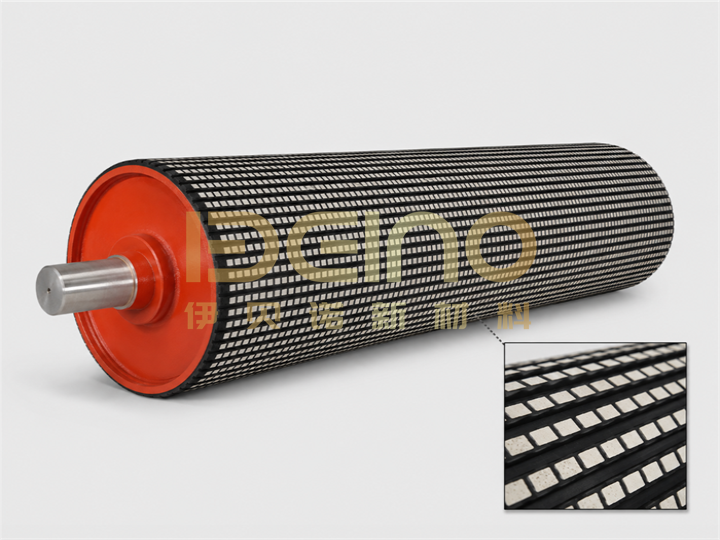
Elacera ceramic pulley lagging combines high-hardness alumina ceramic elements with a resilient rubber backing.
The raised ceramic contact points engage the underside of the conveyor belt, helping maintain traction when the surface is wet or contaminated. The rubber layer provides flexibility and helps the lagging conform to the pulley surface, while the spaces between the ceramic elements allow water, mud, and fine material to escape.
The result is a more stable contact surface for high-tension drive pulleys operating in abrasive environments.
Traction performance still depends on the complete conveyor system, including wrap angle, take-up tension, belt condition, alignment, and pulley condition. Ceramic lagging should be selected as part of the conveyor design rather than treated as a universal repair material.
Is Ceramic Lagging Right for Your Pulley?
Ceramic pulley lagging is a strong candidate when:
- The drive pulley repeatedly slips in wet or muddy conditions.
- Conventional rubber lagging wears out too quickly.
- The conveyor handles coal, iron ore, aggregates, or abrasive mineral fines.
- The pulley operates under high tension or frequent loaded starts.
- Relagging requires costly production shutdowns.
- Material buildup and surface polishing reduce traction.
Standard rubber lagging may remain the more economical choice for dry, light-duty conveyors where belt slip and rapid wear are not recurring problems.
Before recommending ceramic lagging, the pulley shell, belt alignment, wrap angle, and take-up system should also be checked. Lagging cannot correct a damaged pulley or a fundamentally misaligned conveyor.
Bonding and Installation Matter as Much as the Ceramic
Many premature lagging failures begin at an edge, joint, or poorly prepared pulley surface—not at the ceramic wear face.
A reliable installation normally requires:
- Complete removal of old rubber, adhesive, and contamination.
- Mechanical preparation of the pulley surface.
- Proper cleaning, priming, and adhesive application.
- Accurate positioning of the ceramic rubber sheets.
- Careful rolling and sealing of edges and joints.
- Sufficient curing time before the conveyor is restarted.
Operating temperature, moisture, chemical exposure, and shutdown duration must be reviewed before selecting the bonding system.
Technical Reference
| Item |
Typical Specification |
| Ceramic material |
Alumina ceramic |
| Alumina content |
≥95% |
| Ceramic density |
≥3.75 g/cm³ |
| Ceramic hardness |
≥85 HRA |
| Composite structure |
Ceramic elements factory-vulcanized into rubber |
| Surface design |
Raised ceramic contact points with drainage gaps |
| Dimensions |
Customized to pulley diameter and face width |
| Temperature and chemical limits |
Confirmed according to the rubber and bonding system |
Information Required for a Reliable Quotation
To recommend the correct lagging layout, please provide:
- Pulley diameter and face width
- Belt width, speed, and thickness
- Drive power and pulley position
- Belt tension or take-up arrangement
- Conveyed material and particle size
- Wet, muddy, or dry operating conditions
- Operating temperature
- Existing lagging type and failure condition
- Photos of the pulley and conveyor
With this information, the Elacera team can evaluate whether ceramic pulley lagging is suitable and prepare the panel layout, quantity and installation recommendation.
Hunan Yibeinuo New Material Co., Ltd. provides customized wear-resistant ceramic solutions for mining and bulk material conveying systems. Contact Elacera with your pulley data and current operating problem for a practical recommendation.
FAQ
1. What Is Ceramic Pulley Lagging and How Does It Improve Conveyor Traction?
Ceramic pulley lagging is a composite lining made from high-hardness alumina ceramic elements vulcanized into a rubber backing. The raised ceramic surface improves contact with the underside of the conveyor belt, while the rubber layer provides flexibility and cushioning.
In wet, muddy, or abrasive mining conditions, this structure helps the drive pulley maintain more stable traction than a smooth or heavily worn rubber surface.
2. Can Ceramic Pulley Lagging Stop Conveyor Belt Slippage in Wet Conditions?
Ceramic pulley lagging can significantly improve pulley-to-belt traction where water, mud, or fine material reduces the grip of conventional rubber lagging.
However, belt slip may also be caused by insufficient wrap angle, incorrect take-up tension, pulley contamination, belt wear, or conveyor misalignment. These conditions should be checked before relagging the pulley.
3. Will Ceramic Pulley Lagging Damage the Conveyor Belt?
Properly selected and installed ceramic pulley lagging should not damage a suitable conveyor belt under normal operating conditions.
The ceramic elements are embedded in rubber and arranged to provide controlled contact with the belt. Belt damage is more likely when there are sharp exposed edges, broken ceramic elements, incorrect installation, excessive belt tension, or material trapped between the belt and pulley.
Why Does Ceramic Pulley Lagging Debond from the Pulley?
Debonding is often related to installation or operating conditions rather than ceramic wear. Common causes include:
- Incomplete removal of old rubber and adhesive
- Rust, oil, dust, or moisture on the pulley surface
- Inadequate surface preparation
- Incorrect primer or adhesive selection
- Uneven adhesive application
- Poorly sealed sheet edges and joints
- Insufficient curing time
- Operating temperature or chemical exposure beyond the bonding system’s limit
- Pulley deformation or abnormal conveyor vibration
Careful surface preparation and strict control of the bonding process are essential for reliable performance.

 Your message must be between 20-3,000 characters!