Highlight:
Cement Plant Conveyors Ceramic Pulley Lagging
, Ceramic Pulley Lagging Sheet
Ceramic Pulley Lagging For Cement Plant Conveyors
Product Description
In a cement plant, pulley lagging represents only a small part of the conveyor budget. Its failure, however, can interrupt an entire conveying line.
Once the surface of a drive pulley becomes polished or worn, the conveyor belt may begin to slip during startup or under heavy load. Operators often respond by increasing belt tension, but this can place additional stress on the belt, splice, bearings, and pulley shaft without solving the underlying traction problem.
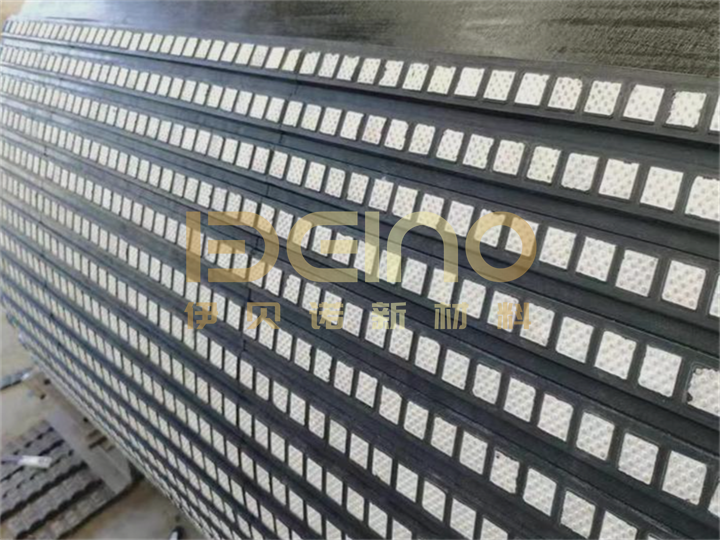
Elacera ceramic pulley lagging combines high-alumina ceramic elements with a resilient rubber backing. It is developed for drive pulleys handling abrasive materials such as limestone, clinker, coal, additives, and raw meal.
It is particularly suitable for positions where ordinary rubber lagging loses its grip, wears out quickly, or requires repeated replacement.
When Is a Ceramic Pulley Lagging Better Than Rubber?
Standard rubber lagging remains a practical choice for many light- and medium-duty conveyors. Ceramic lagging becomes worth considering when traction loss and repeated maintenance begin to affect production.
The rubber becomes smooth before it is fully worn
Fine cement and mineral dust can gradually polish the rubber surface. The lagging may still have sufficient thickness, but its ability to maintain traction has already declined.
- Typical signs include:
- Belt slipping during startup
- Repeated belt tension adjustment
- Polished or glazed rubber surfaces
- Heat is generated between the belt and the pulley
- Unstable operation under changing loads
Increasing belt tension may temporarily reduce slipping, but it can also transfer more load to other conveyor components.

Lagging replacement requires a major shutdown
Replacing pulley lagging is rarely limited to removing one sheet and installing another.
Depending on the pulley location, the work may involve belt lifting, scaffolding, old rubber removal, surface grinding, cleaning, adhesive application, and curing time. If access is difficult, labour and lost production can cost far more than the lagging itself.
For these positions, a longer and more stable maintenance interval may be more valuable than the lowest initial sheet price.
The conveyor starts under a heavy load
A fully loaded clinker, limestone, or coal conveyor places high demand on the drive pulley during startup.
If the contact surface is worn or contaminated with dust, the belt may slip before reaching normal operating speed. Repeated slipping generates heat and accelerates wear on both the belt and the lagging.
Where heavy startup load, abrasive dust, and limited maintenance access occur together, ceramic rubber pulley lagging can provide a more dependable alternative.
How Ceramic Rubber Pulley Lagging Works
Ceramic pulley lagging does more than provide a harder-wearing surface. Its performance comes from the interaction among the ceramic elements, the rubber backing, and the surface pattern.
Each part has a specific function:
- High-alumina ceramic surface: Resists abrasive wear caused by cement raw materials, coal, clinker dust, and mineral particles.
- Raised ceramic contact profile: Improves the grip between the conveyor belt and the drive pulley.
- Resilient rubber layer: Absorbs vibration and accommodates limited impact during operation.
- Surface grooves: Help discharge dust, moisture, and loose particles from the contact area.
- Flexible sheet backing: Allows the lagging to follow the curvature of the pulley shell.
This structure is well-suited to heavily loaded drive pulleys that operate for long hours and cannot be repaired frequently.
Ceramic Pulley Lagging Applications in Cement Plants
Ceramic lagging is not required on every conveyor pulley. It should be prioritised where belt traction, abrasive wear, and shutdown cost justify the upgrade.
Typical cement plant applications include:
- Limestone crushing and conveying systems
- Raw material handling conveyors
- Clinker conveying lines
- Coal handling systems
- Additive feeding conveyors
- Stockyard reclaim systems
- Packing plant conveyors
- Long-distance belt conveyors
- High-duty drive pulleys
- Bucket elevator drive pulleys, subject to equipment review
For non-drive pulleys or lightly loaded positions, standard rubber lagging may remain the more economical choice.
Technical Specification
| Property |
Typical Value |
| Product structure |
High-alumina ceramic and rubber composite |
| Alumina content |
≥95% |
| Ceramic density |
≥3.75 g/cm³ |
| Ceramic hardness |
≥85 HRA |
| Bending strength |
≥330 MPa |
| Sheet dimensions |
Customised |
| Ceramic layout |
Selected according to pulley duty |
| Main application |
Conveyor drive pulleys |
| Installation method |
Subject to pulley and site conditions |
The values above are typical product data. Final dimensions, ceramic arrangement, rubber specification, and installation materials should be confirmed according to the agreed technical requirements.
Select the Lagging According to the Conveyor Duty
Two pulleys with the same diameter may operate under very different conditions.
One may handle dry limestone at a moderate belt speed. Another may start under a full clinker load and run continuously for most of the day. Using the same ceramic layout and rubber thickness for both pulleys will not necessarily produce the same result.
Before selecting the lagging, the following information should be reviewed:
- Drive or non-drive pulley
- Pulley diameter and face width
- Conveyor belt width
- Belt speed
- Motor power and startup method
- Belt tension
- Conveyed material
- Material temperature
- Dust and moisture level
- Impact and vibration
- Operating hours per day
- Current lagging type
- Existing failure mode
- Available shutdown time
- Site or workshop installation
The sheet size, ceramic arrangement, and rubber thickness can then be matched to the pulley geometry and operating load
Installation Quality Matters as Much as Material Quality
Even a good ceramic pulley lagging can fail early if the pulley surface is not properly prepared.
Common causes of peeling or edge separation include:
- Incomplete removal of old rubber and adhesive
- Insufficient grinding or surface roughness
- Oil, dust, or moisture contamination
- Incorrect adhesive mixing ratio
- Uneven bonding pressure
- Insufficient curing time
- Poorly sealed joints and edges
- Start up before the adhesive has fully cured
The adhesive, primer, and cleaning system should be compatible with the lagging and the pulley shell. Site temperature, humidity, and available curing time must also be considered before installation begins.
If the pulley has deep corrosion, an uneven surface, or structural damage, the shell condition should be repaired before new lagging is applied.
Compare Operating Cost, Not Only Sheet Price
A quotation comparison based only on the price per sheet can overlook most of the actual replacement cost.
A complete cost review should include:
- Removal of existing lagging
- Pulley surface preparation
- Adhesive, primer, and cleaning materials
- Labour and supervision
- Belt lifting
- Scaffolding
- Production shutdown
- Adhesive curing time
- Repeat maintenance
- Belt damage caused by continued slipping
If less expensive rubber lagging must be replaced during every major shutdown, while a correctly selected ceramic lagging system remains stable for several maintenance cycles, the initial price difference may be small compared with the avoided labour and production loss.
However, service life should never be promised from a catalogue alone. It depends on the actual conveyor load, installation quality, belt condition, conveyed material, and operating environment.
Why Choose Elacera Ceramic Pulley Lagging?
Hunan Yibeinuo New Material Co., Ltd. does not select ceramic pulley lagging only by sheet size.
Before quotation, our team reviews the pulley dimensions, conveyor duty, and existing failure conditions. This helps determine whether ceramic lagging is suitable and what information must be confirmed before production.
Elacera can provide:
- High-alumina ceramic rubber lagging
- Customised sheet dimensions
- Ceramic layout matched to pulley geometry
- Technical review based on conveyor duty
- Inspection of dimensions and surface condition
- Installation material recommendations
- Protected export packing
- Technical documents according to order requirements
Our goal is not simply to replace the existing lagging with a harder material. It is to identify why the current lagging is failing and provide a solution that fits the conveyor.
Information Required for Quotation
For a technical review and quotation, please provide:
- Pulley drawing
- Pulley diameter
- Pulley face width
- Conveyor belt width
- Belt speed
- Drive power
- Conveyed material
- Material temperature
- Operating hours per day
- Existing lagging type
- Description of the current problem
- Photographs of the worn pulley
- Required quantity
- Installation location
A photograph of the worn surface is often more useful than simply requesting “the same lagging as before.”
FAQ
Can ceramic pulley lagging be installed on-site?
Yes, depending on the pulley condition and the available installation environment. Proper surface preparation, adhesive application, bonding pressure and curing time are essential. Workshop installation may be preferable when site access or environmental conditions are unsuitable.
What adhesive is used for ceramic pulley lagging?
The adhesive and primer must be compatible with the rubber backing and steel pulley shell. Selection should also consider site temperature, humidity and curing time. Mixing products from unrelated adhesive systems is not recommended.
What causes ceramic pulley lagging to peel away?
Common causes include poor surface preparation, oil or moisture contamination, incorrect adhesive mixing, insufficient pressure, inadequate curing, poorly sealed joints, and operating conditions outside the original design range.
Can ceramic pulley lagging be customised?
Yes. Sheet dimensions, ceramic arrangement, and rubber thickness can be adjusted according to the pulley diameter, face width, and conveyor duty. A pulley drawing is recommended before production.
What is the difference between ceramic and rubber pulley lagging?
Rubber lagging relies mainly on its rubber surface to provide friction. Ceramic lagging uses hard ceramic contact elements to improve grip and resist abrasive wear, while the rubber backing provides flexibility and vibration absorption.
Request a Technical Review
If your cement conveyor is experiencing belt slippage, polished rubber lagging, or frequent pulley maintenance, send the pulley drawing and operating information to Hunan Yibeinuo New Material Co., Ltd.
Elacera will review the actual operating condition and recommend a ceramic pulley lagging solution suitable for the conveyor duty.

 Your message must be between 20-3,000 characters!