Highlight:
Customizable Wear Resistant Ceramic Pipe
, Seamless Wear Resistant Ceramic Pipe
, Seamless Abrasion Resistant Elbow
Custom Alumina Ceramic Lined Elbow for Abrasive Conveying
Product Description
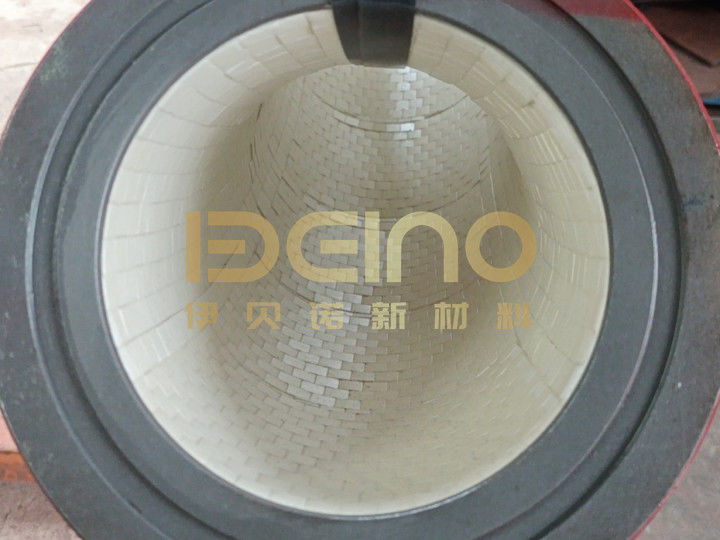
ELACERA® ceramic-lined elbows are used where abrasive powders and granular materials change direction inside a conveying system. The steel elbow provides the pressure-bearing and structural body, while 92% alumina ceramic tiles protect the internal surface from sliding wear and particle impact.
The lining is installed after the steel elbow has been formed. Ceramic size, thickness, and arrangement are selected according to the elbow diameter, bend radius and operating conditions.

Product Details
|
Item
|
Specification
|
| Brand |
ELACERA® |
| Product Type |
Ceramic Tile Lined Steel Elbow |
| Ceramic Material |
92% Alumina Ceramic |
| Outer Pipe |
Carbon Steel or Stainless Steel |
| Lining Structure |
Closely Fitted Ceramic Tiles |
| Ceramic Arrangement |
Staggered Joints |
| Elbow Angle |
Customized |
| Center-Line Radius |
According to Drawing |
| Ceramic Thickness |
Customized |
| End Connection |
Flanged, Welded, or Other Specified Connection |
| Application |
Pneumatic and Mechanical Conveying of Abrasive Materials |
| Production Basis |
Confirmed Drawing or Existing Sample |
| Packaging |
Wooden Case or Steel Rack |
| Delivery Time |
Normally 25–45 Working Days |
Why Elbows Usually Wear Before Straight Pipes
Material does not travel through an elbow in the same way it travels through a straight pipe. When the flow changes direction, particles continue moving toward the outside radius. The outer bend therefore receives more sliding contact and direct impact than the inner radius.
The difference becomes more obvious when conveying coarse particles, materials with irregular shapes or mixtures with unstable flow conditions. A small-radius elbow may also experience more concentrated wear than a long-radius bend.
Simply using the same ceramic arrangement over the complete elbow may not be the most suitable solution. The ceramic thickness and tile layout around the outer radius should be reviewed separately, particularly when previous steel elbows have worn through at the same position.
Ceramic Layout Inside the Bend
This elbow uses individual alumina ceramic tiles rather than a single ceramic sleeve. The smaller pieces follow the curved internal surface and can be arranged more accurately around different elbow diameters and bend radii.
The joints are staggered so that the material does not travel continuously along one straight joint. During lining, attention is given to the outside radius, both end transitions and any area where the steel surface could remain exposed.
A tile-lined structure is particularly practical for large diameters and non-standard elbows. For small-diameter pipelines, an integral ceramic sleeve or segmented ceramic ring may be considered instead. The selection depends on the internal diameter, elbow geometry and impact level.
Typical 92% Alumina Ceramic Parameters
|
Items
|
Specifications
|
|
Al2O3%
|
≥92%
|
|
Fe2O3%
|
≤0.20%
|
|
Mohs' hardness
|
9
|
|
Water Absorption (%)
|
≤0.02
|
|
Density(g/cm3)
|
≥3.60
|
|
Abrasion(%)
|
≤0.02
|
These are typical material values. The final ceramic grade and test requirements should be confirmed in the order specification.
The End Transition Needs Careful Control
A ceramic-lined elbow can still develop premature local wear when the internal transition is not smooth. If the ceramic is lower than the adjoining pipe, part of the steel wall may remain exposed. If it is higher, the ceramic edge may repeatedly intercept the material flow.
For this reason, the finished internal diameter should be checked after lining. The ceramic at both ends should align with the adjoining pipe, and the remaining welding length or flange transition should follow the installation drawing.
The steel elbow itself also requires dimensional control. The bend angle, center-line radius, tangent length, and flange orientation affect whether the component can be installed without forcing the surrounding pipeline out of alignment.
Where These Elbows Are Used
Ceramic-lined elbows can be installed in pipelines conveying:
- Pulverized coal
- Fly ash and bottom ash
- Limestone powder
- Cement and clinker dust
- Mineral concentrate
- Sand and abrasive particles
- Steel-plant dust and slag particles
- Other dry bulk materials
Actual lining selection should consider particle size, flow velocity, impact angle, operating temperature and whether the system works under pressure or vacuum.
FAQ
Is this an integral ceramic elbow?
No. The product shown on this page is a steel elbow lined with individual alumina ceramic tiles. Integral ceramic sleeves are normally considered for smaller or more regular internal diameters.
Why are the ceramic joints staggered?
Staggered joints prevent the material from following one continuous seam through the elbow. They also reduce the possibility of exposing a direct wear path to the steel surface.
Can the outside radius use thicker ceramic?
Yes. When wear is concentrated on the outer bend, thicker ceramic or a different ceramic grade can be arranged in that area according to the drawing and operating conditions.
Can both flanged and welded elbows be produced?
Yes. Flanged, welded, and other specified end connections can be manufactured. Flange orientation and the remaining welding length should be marked clearly on the drawing.
How is the finished internal diameter controlled?
The steel elbow diameter, adhesive layer, and ceramic thickness are considered together. The lined bore and both end transitions are checked before delivery.
Can an existing worn elbow be reproduced?
Yes. Production can be based on a confirmed drawing or an existing sample. The bend angle, center-line radius, tangent length, connection dimensions, and location of the most serious wear should be checked before manufacturing.
When replacing an elbow that repeatedly wears through at the outer radius, send ELACERA® a photo of the worn section together with the original drawing. This makes it easier to determine whether the ceramic thickness or lining arrangement needs to be adjusted.

 Your message must be between 20-3,000 characters!