Highlight:
Customized Wear Resistant Ceramic Pipe
, Customized Ceramic Lined Reducer Pipe
, Wear Resistant Ceramic Pipe Smooth
Customized Wear Resistant Ceramic Pipe Smooth Surface Ceramic Lined Reducer Pipe
Product Description
Replacing a worn reducer in an existing plant often means working within fixed dimensions. The adjoining pipes, flanges and supports are already installed, leaving limited freedom to change the distance or alignment between the two ends.
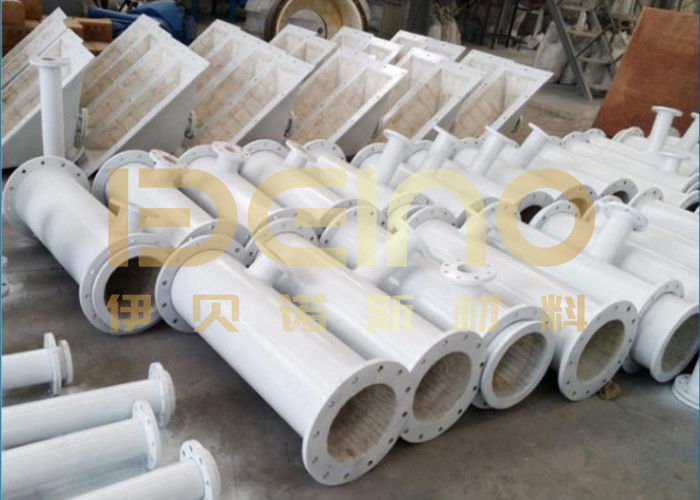
ELACERA ceramic-lined reducer pipes are manufactured for abrasive conveying lines that need a drawing-matched replacement. The alumina lining protects the internal wear surface, while the finished fitting is configured to suit the available installation space and connections.

Define the Installation Length Before the Taper
Two nominal pipe sizes do not fully define a replacement reducer. Components with the same large and small ends may have different overall lengths, straight-end sections, and connection details.
For a flanged reducer, state the required face-to-face dimension between the mating flange faces. This is not necessarily the same as the length of the tapered section. Flange thickness and straight collars also occupy installation space.
For welded ends, identify the measurement reference points and required end preparation. The drawing should distinguish the complete fitting length from the ceramic-lined length.
If the existing component is worn or distorted, check its dimensions against the installed piping rather than reproducing every feature of the removed part.
Confirm Concentric or Eccentric Geometry
A concentric reducer keeps the large and small bores on a common centerline. An eccentric reducer offsets the two centerlines.
That difference affects how the fitting connects to the existing pipework. An eccentric replacement needs the offset dimension and its installed orientation, not just two diameters and an overall length.
For horizontal installations, the drawing should identify which surface or centerline must remain at the existing elevation. Flange bolt-hole orientation should be referenced to that same installation position.
These details are especially important when the reducer connects to equipment that cannot be moved. A fitting may match the flange drilling yet still place the smaller pipe at the wrong height.
The required arrangement should therefore be confirmed from the piping layout, with site measurements used where the original drawing is incomplete.
Specify Each Connection Separately
The two ends of a reducer do not always have identical connection requirements. Record the flange standard, nominal size, pressure class, facing and drilling at each end.
Matching the bolt holes alone does not confirm that two sealing faces are compatible. The gasket arrangement and the position of the ceramic relative to the sealing face also require review.
For welded connections, agree on the welding allowance and procedure before lining manufacture. Unplanned field welding can expose the nearby lining and bonding system to heat.
The finished internal opening should be checked against the actual adjoining component. This is particularly useful where the reducer connects to an already-lined pipe whose bore differs from an unlined pipe of the same nominal size.
Neither end should be treated as a generic connection simply because its nominal diameter is familiar.
Alumina Ceramic Reference Properties
|
Item
|
Reference Value
|
|
Al₂O₃ Content
|
≥95%
|
|
Rockwell A Hardness
|
≥85 HRA
|
|
Flexural Strength
|
≥330 MPa
|
|
Fracture Toughness
|
≥4.0 MPa·m¹ᐟ²
|
Final material requirements should follow the agreed specification and inspection documents. These values describe the ceramic material; they do not define the allowable pressure or temperature of the complete reducer.
Ceramic thickness and the fixing system are selected after reviewing the conveyed material and operating conditions. Any proposed lining change must also fit within the agreed finished dimensions.
Inspection for a Replacement Fitting
The inspection plan should address the features that determine whether the reducer will fit the installed line.
Key checks include:
- Face-to-face or specified overall length
- Large-end and small-end dimensions
- Centerline alignment or eccentric offset
- Flange orientation and connection details
- Sealing-face condition
- Finished openings and ceramic termination
- Visible lining damage around both ends
For an eccentric fitting, mark its installation orientation clearly. For several similar replacement parts, identify each component against its drawing or installation position.
Dimensional tolerances, inspection records and any required pressure testing should be agreed before production. A photograph of the finished reducer is useful, but it does not replace checks of the critical installation dimensions.
FAQ
Is face-to-face length the same as the cone length?
No. Face-to-face length includes the complete distance between the mating faces. Straight sections, collars and flanges may extend beyond the tapered portion.
Can the opposite ends have different flange requirements?
Different end requirements can be reviewed from the drawing. Each end must be specified separately, and compatibility with the connected equipment must be checked. Different flange classes do not automatically give the complete assembly the higher rating.
Can an eccentric reducer be rotated during installation?
Its rotational position should follow the approved piping layout. Rotation changes the direction of the offset and can move the smaller connection away from the required position, even when the bolt holes still align.
ELACERA manufactures ceramic-lined reducer pipes according to confirmed component drawings. For a replacement, the existing installation dimensions and connection details are reviewed alongside the wear-protection requirements.

 Your message must be between 20-3,000 characters!