Highlight:
ceramic rubber wear liners
, rubber ceramic liners with warranty
, embedded ceramic rubber liners
Product Description
At high-impact transfer points, abrasion is only part of the wear problem. Large particles, high drop heights, and repeated impact can crack rigid liners or loosen ceramic tiles, while conventional rubber liners may wear too quickly under continuous material flow.
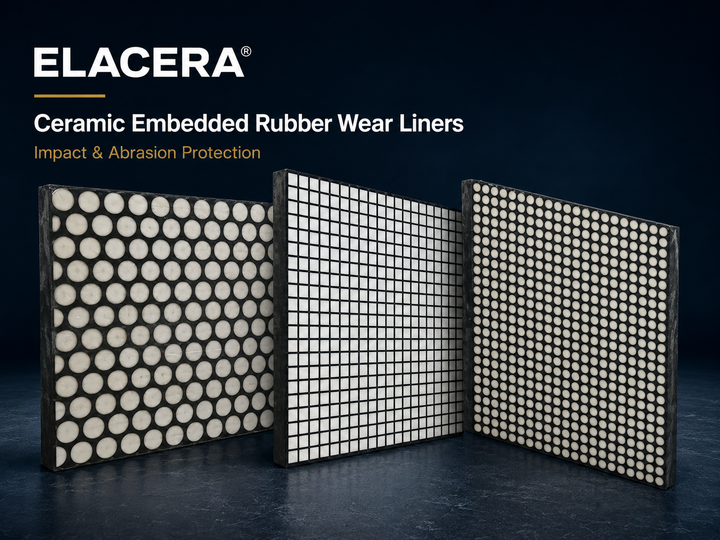
Elacera® ceramic embedded rubber wear liners combine wear-resistant alumina ceramics with an impact-absorbing rubber matrix. The ceramic elements resist sliding abrasion, while the surrounding rubber cushions impact, vibration, and structural stress.
This design is particularly suitable for chutes, hoppers, bins, and transfer points handling ore, coal, clinker, slag, and other abrasive bulk materials.
HOW THE COMPOSITE STRUCTURE WORKS
Wear-Resistant Ceramic Surface
The alumina ceramic elements form the primary wear surface and protect the equipment from continuous abrasion.
Impact-Absorbing Rubber Matrix
Elastic rubber absorbs part of the impact energy and reduces the risk of ceramic cracking or detachment.
Embedded Ceramic Design
The ceramics are securely vulcanized into the rubber, protecting their edges and improving stability under repeated impact.
Optional Steel Backing
For heavy-duty applications, the liner can be supplied with a steel backing plate, studs, or bolt holes for mechanical installation.

KEY BENEFITS
• Combines abrasion resistance with impact absorption
• Reduces ceramic cracking and liner detachment
• Helps lower vibration and operating noise
• Suitable for curved or irregular equipment surfaces
• Available in customized sizes, shapes, and thicknesses
• Easier to replace than permanently welded steel liners
TYPICAL TECHNICAL PARAMETERS
Ceramic Material: 95% Alumina Ceramic
Ceramic Density: ≥3.75 g/cm³
Ceramic Hardness: ≥85 HRA
Flexural Strength: ≥330 MPa
Compressive Strength: ≥1200 MPa
Rubber Tensile Strength: ≥12 MPa
Rubber Elongation: ≥250%
Rubber Hardness: 55–65 Shore A
Ceramic-Rubber Bond Strength: ≥3.0 MPa
Standard Operating Temperature: −40°C to +80°C
Higher-Temperature Grades: Available on Request
Parameters can be adjusted according to impact level, material size, operating temperature, and installation requirements.
APPLICATIONS
Mining
Transfer chutes, crusher discharge areas, ore bins, vibrating feeders, and screening equipment.
Cement Plants
Clinker chutes, raw material hoppers, crushers, cyclones, and transfer points.
Coal-Fired Power Plants
Coal bunkers, coal chutes, ash handling systems, and pyrite discharge equipment.
Steel and Smelting
Sinter chutes, blast furnace feeding systems, slag handling equipment, and storage bins.
Ports and Bulk Material Handling
Ship loaders, unloading hoppers, conveyor transfer stations, and material handling chutes.
LINER SELECTION GUIDANCE
Embedded alumina ceramic rubber liners are suitable for equipment exposed to both abrasive sliding wear and repeated impact.
Before selecting the liner structure, the following operating conditions should be evaluated:
• Conveyed material and particle size
• Drop height and impact angle
• Material flow rate
• Operating temperature
• Existing equipment dimensions
• Installation and maintenance space
For extremely high impact, large lump materials, or concentrated direct impact, a ZTA ceramic rubber liner or a thicker ceramic structure may be more suitable.
CUSTOMIZATION AND INSTALLATION
Elacera® can customize the ceramic arrangement, rubber thickness, overall dimensions, steel backing, bolt holes, and fastening method according to equipment drawings.
Bolt-on installation is recommended when fast replacement and maintenance are required. Steel-backed liners with studs can be used where stronger mechanical fixing is necessary.
FAQ
Q1: What is the difference between an embedded ceramic rubber liner and a rubber liner?
The embedded ceramic liner provides a hard, wear-resistant surface, while the rubber matrix absorbs impact. A rubber-only liner offers good cushioning but normally has lower abrasion resistance.
Q2: When should ZTA ceramics be considered?
ZTA ceramics are recommended for more severe impact conditions, especially where large particles, high drop heights, or concentrated impact may cause standard alumina ceramics to crack.
Q3: Can the liner size and ceramic arrangement be customized?
Yes. The liner dimensions, ceramic shape, ceramic arrangement, rubber thickness, and fixing method can be customized according to equipment drawings and operating conditions.
Q4: How are the liners installed?
Common installation methods include embedded bolts, steel-backed studs, and bolt-on fixing. The appropriate method depends on the equipment structure and maintenance requirements.
Q5: What information is needed for liner selection?
Please provide the conveyed material, particle size, drop height, operating temperature, equipment dimensions, wear location, and installation drawings.
CONTACT ELACERA®
Send us your equipment drawings and operating conditions. Our wear protection engineers will recommend a suitable ceramic structure, rubber thickness, and installation method for your application.

 Your message must be between 20-3,000 characters!