Highlight:
wear resistant ceramic lined pipe
, alumina ceramic slurry transport pipe
, ceramic lined steel pipe
Wear Resistant Ceramic Lined Steel Pipe for Slurry Transport
Product Description
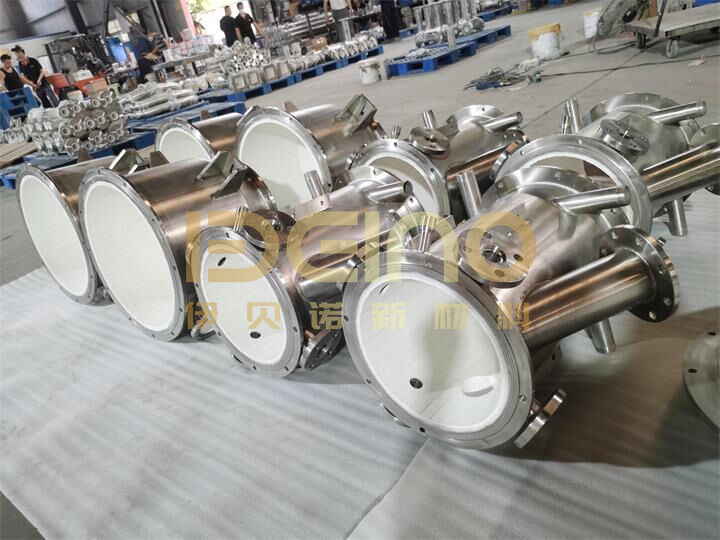
Wear-resistant ceramic steel pipe is a composite wear-resistant pipe comprising a high-density alumina ceramic inner lining and a high-quality steel outer pipe. It is specifically designed to convey highly abrasive materials in the mining, metallurgy, thermal power, cement, and chemical industries. The pipe uses advanced technology to firmly bond the ceramic layer to the steel pipe, combining the high wear resistance and erosion resistance of ceramics with the high strength and impact resistance of steel pipes. This significantly extends the pipeline's service life and reduces replacement and downtime costs, making it an ideal choice for conveying media such as slurry, ash, pulverized coal, and tailings.
Product Features
* The inner lining is made of high-purity, high-density alumina ceramic, offering high hardness, erosion resistance, and resistance to particle cutting.
* The ceramic layer thickness is rationally designed for durability and resistance to cracking and detachment.
* The ceramic-steel pipe bonding strength is high, providing vibration resistance, temperature difference resistance, and thermal shock resistance.
* The smooth inner wall prevents scaling and material blockage, resulting in low conveying resistance and lower energy consumption.
* It can withstand complex working conditions such as high temperatures and acid/alkali corrosion.

Product Advantages
Superior Wear Resistance: The ceramic layer's wear resistance is 10-20 times that of ordinary steel pipes, with a particularly significant increase in lifespan at elbows.
Longer Service Life: Overall service life is 3-6 times longer than traditional pipes, greatly reducing replacement frequency.
More Stable Operation: No detachment, cracking, or perforation, reducing the risk of unplanned downtime.
High Adaptability: Adaptable to different slurry concentrations, particle hardness, flow rates, and temperature environments.
Reduced Overall Costs: Longer service life, less maintenance, lower energy consumption, and lower total lifespan cost.
Export Quality Assurance: Standardized production, rigorous testing, and precise dimensions meet international engineering standards.
Product Process
| Manufacturing processes |
Processing steps |
| Pipe bending process |
Bending - Welding - Inspection - Polishing - Derusting |
| Wear-resistant ceramic processing flow. |
Ball Milling-Milling-Formulation-Forming-Firing-Quality Inspection |
| Wear-resistant ceramic installation |
Internal cleaning of the pipe - gluing the inner wall of steel parts - ceramic gluing - pasting - cleaning inside the pipe |
| Product Inspection |
Pipe Flange Dimension Inspection - Weld Inspection - Pressure Inspection |
| Packing and shipping |
Bubble film packing - wooden box or iron frame packing - delivery photos and videos available - ex-factory |
Product Structure
| Item |
Thickness |
Material |
Product Features |
| Steel tube |
5~10mm |
20# seamless pipe |
High strength, can resist high pressure |
| Viscose |
0.5~1mm |
Epoxy resin |
High-strength adhesive force, no aging, good thermal expansion |
| Ceramic |
5~10mm |
95% alumina ceramics |
Super wear-resistant, good toughness |
Why do ceramic pipes have such different lifespans?
This is a common problem encountered by many customers on project sites.
In some projects, ceramic steel pipes can operate stably for several years, while in others, severe localized wear, ceramic detachment, or even pipe failure begin to appear in less than a year. Many people's first reaction is to attribute it to product quality issues, but in reality, in most cases, the operating parameters and structural design truly affect lifespan.
Take slurry transportation as an example. The hardness, particle size, and concentration of particles in the slurry directly affect the wear rate. Especially in conditions containing a high proportion of quartz particles, the high hardness of quartz significantly intensifies the erosion of the pipe wall. If the particle edges are sharp, they can also create a cutting effect, causing continuous damage to the ceramic layer.
At the same time, the flow rate is also a crucial factor. Many sites continuously increase the flow rate to improve efficiency, but with increased flow rate, the energy of particles impacting the pipe wall increases significantly. The wear rate often doesn't simply increase, but rather exhibits "accelerated wear."
This problem is particularly noticeable at bends. Because particles are affected by inertia during bends, a large number of particles continuously impact the outer arc area of the bend. Therefore, in many piping systems, the first parts to fail are often not the straight pipes, but the bends.
Therefore, in actual projects, we usually advise clients to focus on reinforcing high-wear areas such as bends, tees, and reducers, rather than simply pursuing a "uniform thickness" throughout the entire pipeline.
Ceramic technical index
| Item |
Index |
| Alumina content |
≥95% |
| Density |
≥3.8 g/cm3 |
| Rockwell hardness |
≥85 HRA |
| Compressive strength |
≥1500 MPa |
| Fracture toughness KΙC |
≥5MPa·m1/2 |
| Bending strength |
≥330MPa |
| Thermal Conductivity |
20W/m.k |
| wear and tear |
≤0.0002g |
| Ceramic thickness |
5~10mm |
Adhesive technical indicators
| Type |
Ceramic-Steel Shear Strength |
Tensile strength |
Coefficient of thermal expansion |
Temperature range |
Color |
| WD-3032 |
2.5MPa |
8 MPa |
9×10⁻⁶m/ m·K |
350℃ |
cream color |
Comparison of self-propagating wear of wear-resistant ceramics and centrifugal casting
| Index |
Alumina ceramic lined pipe elbows |
Centrifugal casting of self-propagating composite ceramic pipes |
| Alumina content |
95% alumina |
60-80% |
| Measured hardness |
≥85HRA |
HRA60 |
| wear and tear |
≤0.0002g(P=74N,N=800rpm,t=300min.) |
≤0.0025(P=74N,N=800rpm,t=300min.) |
| Compressive strength |
≥1500Mpa |
≤500Mpa |
| compactness |
Dry pressing, smooth and dense |
There are many microscopic cracks, and the particles are large and loose |
| Erosion resistance |
Smooth surface, smooth airflow, good erosion resistance |
There are many microscopic pores, which are easily eroded by airflow, especially fine powder. |
| Elbow forming process |
Overall, hot bending forming, smooth inner wall, natural transition |
The straight pipe is welded in sections, the gap between the shrimps is large, and the transition is not smooth, leaving the hidden danger of wear and tear. |
| Service life (wear through) |
3-8 years or more |
0.6 - 2 years |
Product Structure and Wear-Resistant Principle
Wear-resistant ceramic steel pipes generally consist of three parts:
Outer steel pipe: responsible for overall pressure bearing and structural strength
Middle bonding layer: ensures a firm bond between the ceramic and the steel pipe
Inner alumina ceramic lining: bears the main wear-resistant function
Many customers ask, " Why is alumina ceramic wear-resistant?
The reason lies in its very high hardness and excellent density. High-density ceramics can effectively resist particle erosion while reducing the possibility of particles eroding the internal structure along pores.
However, wear resistance is not simply a matter of "hardness."
If there are many pores inside the ceramic layer or the bonding is weak, even with high material hardness, local delamination or cracking may still occur under long-term impact conditions. Therefore, the density of the ceramic layer, the bonding process, and the construction quality are often more important than simple material parameters.
FAQ
Q1: Is a thicker ceramic layer always better?
A1:No. An excessively thick layer can generate internal stress, increasing the risk of cracking. It needs to be designed appropriately based on the working conditions.
Q2: Why are elbows more prone to wear?
A2: The concentrated impact of slurry particles on the outer side of the elbow due to inertia creates a high-wear area. We use thickened ceramic reinforcement for this purpose.
Q3: Can you recommend a structure based on the working conditions?
A3:Yes. We usually provide a more suitable wear-resistant solution based on the conveying medium, flow rate, and site conditions.
Q4: Do you support customization of complete piping systems?
A4:Yes, including straight pipes, elbows, tees, reducers, and other complete wear-resistant conveying systems.
Q5: Will the ceramic layer peel off?
A5: Using a high-strength composite process, it will not peel off or crack under normal working conditions for long-term use.
Q6: Can you customize pipe diameters and elbow angles?
A6: We support full-specification customization from DN50 to DN800. Elbows, tees, and reducers can all be made to order.
Q7: What is the service life?
A7: Under normal operating conditions, the service life is more than five years, which is much longer than that of traditional pipelines.

 Your message must be between 20-3,000 characters!