Highlight:
Custom Bolt-On Ceramic Rubber Wear Liner for Equipment Retrofits
Custom Bolt-On Ceramic Rubber Wear Liner for Equipment Retrofits
Replacing a worn liner should be straightforward. In practice, the difficulty is not always choosing a more wear-resistant material.
Sometimes the new liner arrives at the plant, the ceramic surface looks correct, but the mounting studs do not match the existing holes. The maintenance team then has to modify the equipment or delay installation.
For a plant working within a short shutdown window, that can become a bigger problem than the liner itself.
This is why we treat a bolt-on ceramic rubber wear liner as more than a wear-resistant panel. It is also a replacement component that must fit the existing equipment.
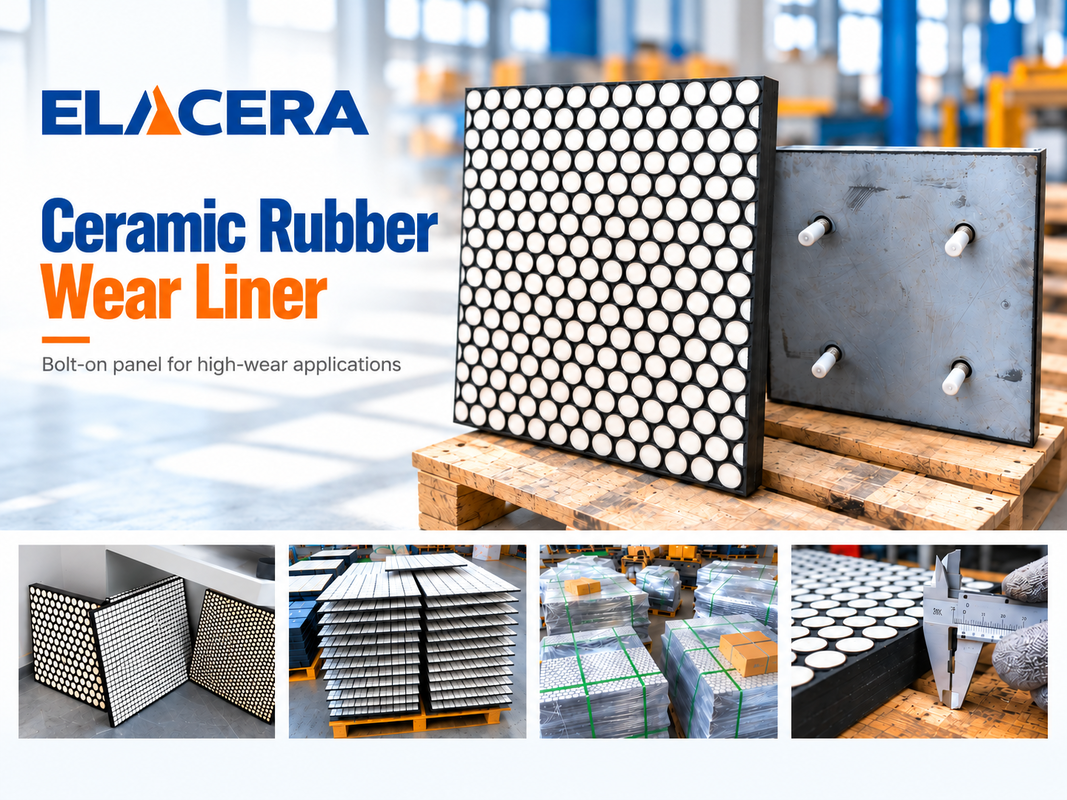
ELACERA supplies customized ceramic rubber steel wear liners with rear mounting studs, manufactured according to drawings, samples, or confirmed installation dimensions.

The Mounting Arrangement Comes First
When we review a replacement liner inquiry, we normally check the existing mounting arrangement before finalizing the ceramic specification.
The important details are often quite practical:
- Panel length, width, and overall thickness
- Number and positions of mounting studs
- Stud diameter and projection length
- Distance from studs to panel edges
- Available installation clearance
- Existing equipment surface and wear condition
For an original equipment project, the mounting arrangement may still be flexible.
For a replacement project, it usually is not.
The existing steel structure, bolt holes, and installation space often determine how the new liner must be manufactured.
A few millimeters of difference in the wrong position may create unnecessary work during installation.
That is why stud positions should be referenced from clearly defined edges or datum points rather than estimated from photographs alone.
Why Combine Ceramic, Rubber and Steel?
The liner uses three materials with different responsibilities.
Alumina ceramic forms the wear-facing surface. Its hardness makes it suitable for resisting abrasion caused by mineral particles, coal, clinker and other abrasive bulk materials.
Rubber supports the ceramic tiles and provides a cushioning layer. This can be useful where sliding abrasion is accompanied by vibration or moderate material impact.
Steel backing provides the structural base and allows welded mounting studs to be incorporated into the finished panel.
Each layer serves a different purpose.
A thicker ceramic layer does not automatically make the liner better. It also increases the total panel thickness and can affect the available clearance inside the equipment.
Likewise, adding rubber is not always necessary for every wear condition.
For mainly sliding abrasion with little impact, a rigid ceramic-and-steel liner may be more appropriate. For stronger repeated impact, the ceramic geometry, rubber structure, and material grade need additional consideration.
The selection should follow the actual wear mechanism rather than a fixed product specification.
Replacement Liners Should Follow the Existing Equipment
One of the advantages of a prefabricated wear panel is that much of the lining work can be completed before the component reaches the plant.
Instead of installing individual ceramic tiles inside a chute or hopper, the maintenance team can work with complete liner panels.
For equipment where the wear is concentrated in specific areas, this also allows individual panels to be replaced.
However, the complete panel still needs to match the installation layout.
For custom orders, we pay attention to the relationship between the ceramic surface, rubber layer, steel backing and stud positions.
An incorrect overall thickness may create an unwanted step between adjacent panels. Incorrect stud spacing can prevent proper installation. Poor edge alignment may leave a section of the equipment exposed to abrasive material.
These details are not particularly complicated, but they are easy to overlook when a quotation focuses only on ceramic grade and unit price.
For us, a replacement liner should be evaluated as a complete installed component, not simply as a ceramic-covered plate.
What We Check During Custom Manufacturing
The steel backing and stud arrangement are prepared according to the confirmed drawing.
The ceramic tiles and rubber layer are then assembled into the required composite structure.
Depending on the selected construction, the ceramic and rubber components can be bonded or vulcanized as part of the manufacturing process.
Before packing, the inspection focuses on the dimensions that affect actual installation.
These include the finished panel size, overall thickness, ceramic coverage, backing condition, stud quantity, and stud positions.
We also pay attention to visible ceramic damage, panel edges, and the condition of the composite structure.
For replacement projects involving multiple panels, part identification and installation orientation can be particularly useful.
A liner may have the correct dimensions but still create installation problems if it is placed in the wrong position or direction.
Where This Design Is Useful
Custom stud-mounted ceramic rubber wear liners can be considered for existing equipment such as transfer chutes, feed hoppers, storage bins and abrasive material discharge sections.
They are particularly useful where the equipment already has a mechanical liner mounting arrangement and the customer wants to replace worn panels without redesigning the complete structure.
The final material and construction still depend on particle size, flow direction, impact level, operating temperature and the existing wear pattern.
We would not recommend the same liner design for every section of a transfer system.
Some areas are dominated by direct impact. Others experience continuous material sliding.
Understanding that difference is usually more important than choosing the thickest available ceramic.
What to Send for a Replacement Quotation
For a custom liner project, an existing drawing is the best starting point.
If the drawing is unavailable, photographs and measurements of the old panel can be used for an initial review.
We normally need the panel dimensions, mounting stud layout, required overall thickness, quantity and basic operating conditions.
Photographs showing the worn surface and the rear mounting arrangement are especially helpful.
ELACERA can review these details and propose a replacement ceramic rubber steel liner suitable for the existing installation requirements.
Frequently Asked Questions
Can the mounting studs match our original liner?
Yes. Stud quantity, diameter, spacing, and projection can be manufactured according to confirmed drawings or samples, subject to the structural design.
Can we change the ceramic thickness without changing the overall liner thickness?
This may be possible by adjusting other layers, but the complete structure must be reviewed. Any change can affect cushioning performance, bonding and installation clearance.
Is a ceramic rubber steel liner suitable for every impact condition?
No. The ceramic shape, rubber construction, and backing design should match the actual impact and abrasion conditions. Severe impact applications require separate evaluation.
Can you manufacture a small quantity for replacement or trial installation?
Customized sample and replacement quantities can be evaluated according to the drawing, ceramic structure, and manufacturing requirements.3
ELACERA | Wear Protection Expert
Need replacement wear liners that fit your existing equipment?
Send us your drawings, mounting dimensions, or old liner photographs for technical review.
www.ybnceramic.com

 Your message must be between 20-3,000 characters!