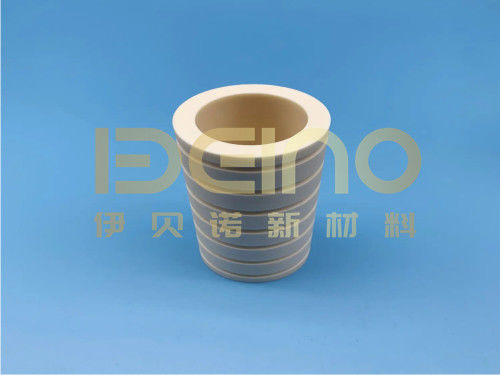
Highlight:
Chemical Resistance Alumina Ceramic Pipe
, Abrasion Resistant Ceramic Lined Tube
, Wear Resistant Ceramic Lined Tube
Alumina Ceramic Pipe Abrasion Resistant Ceramic Lined Tube
Product Description
This alumina ceramic pipe is an abrasion-resistant ceramic-lined tube consisting of a steel outer pipe and a wear-resistant ceramic lining. The steel structure carries the mechanical load, while the ceramic protects the internal surface from abrasion caused by powder, particles, or slurry.
For the buyer, the important question is not simply whether the pipe contains alumina ceramic. The lining structure must match the actual wear mechanism. Dry powder, coarse particles, impact, temperature, and corrosion can require different ceramic grades and fixing methods.
Elacera customizes straight pipes, elbows, reducers, and other fittings according to drawings and operating conditions.

What Should Be Confirmed Before Selection?
- Wear position: Elbows, reducers, inlets, and pipe connections usually wear faster than straight sections.
- Material flow: Particle size and velocity determine whether sliding abrasion or concentrated impact is more serious.
- Operating temperature: The ceramic can withstand high temperatures, but the working limit of the complete pipe depends on the fixing method.
- Finished internal diameter: Ceramic thickness reduces the pipe bore and may affect conveying velocity.
- Connection details: Flange ends and welded connections should avoid exposed steel edges and sudden internal steps.
Technical Specifications
| Items |
Specifications |
| Outer Pipe Material |
Carbon steel or stainless steel according to drawings |
| Ceramic Material |
92%, 95%, 99% alumina or ZTA according to requirements |
| Standard Alumina Content |
≥92% |
| Ceramic Density |
≥3.60 g/cm³ |
| Mohs Hardness |
9 |
| Water Absorption |
≤0.02% |
| Ceramic Thickness |
Selected according to wear conditions |
| Pipe Diameter and Length |
Customized |
| Connection |
Flanged, welded, or customized |
| Main Function |
Abrasion protection for material conveying pipelines |
Available Lining Structures
| Lining Structure |
Suitable Conditions |
| Bonded Ceramic Tiles |
Large diameters, straight pipes, and complicated shapes under suitable temperature and impact conditions |
| Weldable Ceramic Tiles |
Higher temperature, vibration, or stronger mechanical requirements |
| Integral Ceramic Sleeves |
Pipes where suitable ring dimensions can be manufactured and installed |
| Customized Combined Structure |
Local impact zones or pipelines with different wear conditions |
The values above are general references. Final materials, dimensions, and construction are subject to the confirmed drawing and technical requirements.
Typical Applications
Alumina ceramic lined pipes are used in abrasive conveying systems in:
- Cement plants
- Steel plants
- Mining and mineral processing
- Thermal power plants
- Coal handling
- Ports and bulk material terminals
- Chemical and metallurgical industries
For slurry or corrosive media, the steel material, ceramic joints, and fixing system should also be checked for chemical compatibility.
Frequently Asked Questions
Which ceramic lining structure should I choose?
Bonded ceramic tiles are flexible for large-diameter pipes and complicated shapes. Weldable ceramics can be considered where temperature, vibration, or mechanical fixing requirements are higher. Integral ceramic sleeves are suitable only when the required size and pipe geometry allow them to be manufactured and installed.
Can the complete ceramic-lined pipe operate at 1700°C?
No. The ceramic material is fired at a high temperature, but this does not mean the complete composite pipe can continuously operate at 1700°C. The actual working-temperature limit depends on the steel pipe, adhesive, fixing method, and connection design.
What information is needed for technical evaluation?
Please send us the pipe drawing, quantity, conveyed material, particle size, velocity, temperature, pressure, and existing wear position. These details help determine the ceramic grade, thickness, and fixing structure.
Can the pipe dimensions and connections be customized?
Yes. Straight pipes, elbows, reducers, and other fittings can be manufactured according to confirmed drawings. Flanged, welded, and other connection methods are available depending on the pipeline design.
Need help selecting the lining structure? Send Elacera your drawing and operating conditions for a practical wear-protection recommendation.
Elacera — Wear Protection Expert

 Your message must be between 20-3,000 characters!